
Introduction to the Rosary
“The Rosary is a Scripture-based prayer. It begins with the Apostles’ Creed, which summarizes the great mysteries of the Catholic faith. The Our Father, which introduces each mystery, is from the Gospels. The first part of the Hail Mary is the Angel’s words announcing Christ’s birth and Elizabeth’s greeting to Mary. St. Pius V officially added the second part of the Hail Mary. The Mysteries of the Rosary centre on the events of Christ’s life. There are four sets of Mysteries: Joyful, Sorrowful, Glorious and–added by Saint John Paul II in 2002–the Luminous.” – Excerpt from USCCB
“The Apostles’ Creed is so called because it is rightly considered to be a faithful summary of the apostles’ faith. It is the ancient baptismal symbol of the Church of Rome. Its great authority arises from this fact: it is ‘the Creed of the Roman Church, the See of Peter, the first of the apostles, to which he brought the common faith.” – Excerpt from the Catechism of the Catholic Church; 194.
Note From Me:

Image from: https://www.dummies.com/religion/christianity/catholicism/how-to-pray-the-rosary/
This is a direction on how to pray The Rosary modelled after the way my mom taught me. This guide can used by Catholics or believers or anyone who needs help praying The Rosary.
The Rosary can be prayed alone or with a group of believers, led by a prayer lead or said by everyone all together. Turns could be taken to lead the prayer of each mystery as well. From my understanding of the book; The Secret of The Rosary by St. Louis Marie de Montfort, it is gold standard to pray The Rosary in a Catholic Church, in a group, on your knees, and to meditate on the Mysteries of the Life, Death, and Glory of Jesus and Mary. This meditation is the core of praying The Rosary.
As seen on Visitationproject.org: “A PLENARY INDULGENCE is granted, if the Rosary is recited IN A CHURCH OR PUBLIC ORATORY OR IN A FAMILY GROUP, A RELIGIOUS COMMUNITY OR PIOUS ASSOCIATION; a partial indulgence is granted in other circumstances…”The name ‘Rosary,’ however, is commonly used in reference to only a third of the fifteen decades. “The gaining of the plenary indulgence is regulated by the following norms: (a.) “In public recitation the mysteries must be announced in the manner customary in the place; for private recitation, however, it suffices if the vocal recitation is accompanied by meditation on the mysteries. (b.) “The recitation of a third part only of the Rosary suffices; but the five decades must be recited continuously. (c.) “The vocal recitation MUST be accompanied by pious meditation on the mysteries.”
The Rosary can also be prayed anywhere you find yourself. My advice would be to, as much as possible, incorporate the Gold standard in your practice. Take the time to be familiar with the diagram and sequence above, paying attention to the direction of the arrows.
In addition, one could pray all Three Mysteries of the Rosary (Glorious, Joyful, Sorrowful) daily, according to the Book “The Secret of The Rosary” by St. Louis Marie de Montfort or one could pray instead One Mystery daily, according to the Book “True Devotion to The Blessed Virgin” by St. Louis Marie de Montfort. The Luminous Mystery was a later addition after these books by Pope St. John Paul II in 2002, and one may include to one’s daily or weekly prayer, as applicable. The Luminous Mystery points us to Jesus’ Sonship With God, to listen to Jesus, to have a true devotion to Mary, which is to do what Jesus tells us to do or to pay the same devotion to Mary that Jesus did, by listening to her and taking her as Our Mother and Our Queen. The Luminous Mystery comes to its culmination in Jesus’s Institution of The Holy Eucharist, as an Everlasting Offering and a Living Memorial, His Everlasting Thanksgiving Offering to God, His Father. I encourage you to learn more about the Luminous Mystery, through the Catholic Church, as my understanding is only limited.
Note: One may meditate on a Mystery of the Rosary (for instance “The Annunciation” is a Mystery of The Rosary), as they recite Each Decade of The Rosary (one Our Father, 10 Hail Marys, Glory Be and so on..). Alternatively, one may begin this meditation prior to praying Each Decade of The Rosary, paying particular focus to the words being said in each decade of The Rosary, i.e., meditate on the words, imagine Jesus and Mary present (Mary crowned as Queen, carrying in her hands, Baby Jesus crowned as King, holding the world in One Hand, a cross atop the world), and allow yourself to be enveloped and lifted up to God Jesus through Mother Mary. I am not an expert on the Rosary, so what I have shared on this Note is only my viewpoint.
The words prayed in The Rosary are taken or inspired from The Bible. Please refer to the books “True Devotion to The Blessed Virgin” and “The Secret of The Rosary” written by St. Louis Marie de Montfort to learn of the Graces obtained for us through Mother Mary. I’ve tried, in my limitation, to explain briefly below the prayers said when praying The Rosary before beginning the directions about “How to Pray The Rosary”.
“Hail Mary, Full of Grace…(This prayer is Archangel Gabriel’s announcement of the Incarnation of Our Lord Jesus Christ to Mother Mary or as St. Louis Marie de Montfort explains in his book “True devotion to The Blessed Virgin”, “God the Holy Spirit formed Jesus Christ in Mary but only after having asked her consent through one of the chief ministers of His court, and “The world being unworthy,” said Saint Augustine, “to receive The Son of God directly from the Hands of The Father, He gave His Son to Mary for the world to receive Him from her.””)
Blessed are you among women….(St. Louis Marie de Montfort in his book “True devotion to The Blessed Virgin” explains that at this scene of the Visitation, “it was by Mary’s word that Jesus sanctified Saint John the Baptist in the womb of his mother, Saint Elizabeth; no sooner had Mary spoken than John was sanctified. This was His first and greatest miracle of grace.”),
Pray for us sinners… (The Bible mentions intercession still goes on in Heaven in Tobit 12:12 and in Revelations and the best person to intercede for us to Jesus is Mary, Mother of Jesus, who is Full of Grace),
Our Father Who art in Heaven…(Jesus gave us this prayer when He taught us how to pray, and it is a perfect prayer),
Glory Be…(The Bible is full of people praising God. It is good to do the same),
O Our Good Jesus…(A pleasing prayer to God, which asks God to forgive us and others of their sins),
Jesus Have Mercy on us…(A pleasing prayer to God, asking God to forgive us our sins out of the abundance of His mercy, because we are undeserving),
Mother Mary Help us (A pleasing humble prayer to Jesus, asking for the intercession of Mary, out of love for her, Reverence for Jesus and His Sovereignty as God, befitting a mediator, befitting of A King),
May the souls of all the faithful departed…(Praying that God is merciful to all deceased souls of the faithful so that they are granted entrance into heaven. It is a holy practice that is seen in Maccabees).
To Pray The Rosary:
1. Holding The Crucifix, begin by making the sign of the cross. Say: In the name of The Father and of The Son and of The Holy Spirit. Amen.
2. Still holding The Crucifix, recite the introductory prayer below, followed by the Apostles’ Creed:
Lead: Come Holy Spirit, fill the hearts of Your faithful
Response: And enkindle in them the fire of Your love.
Lead: Send forth Your spirit and they shall be created.
Response: And Thou shall renew the face of the earth.
Lead: Let Us Pray
Response: O God, who by The Light of the Holy Spirit, did instruct the hearts of the faithful. Grant by The Same Holy Spirit, we may be truly wise and ever rejoice in His Holy Consolation through The Same Christ, Our Lord. Amen.
Lead: And Thou O Lord shall open up our lips
Response: And our tongue shall announce Thy praise
Lead: Incline unto our aid O Lord
Response: O Lord make haste to help us.
Glory Be:
Lead: All Glory be to the Father, to the Son and to the Holy Spirit
Response: As it was in the beginning, is now and ever shall be, world without end. Amen
The Apostles’ Creed:
Lead: I believe in God, the Father Almighty, Creator of Heaven and earth; and in Jesus Christ, His only Begotten Son Our Lord, Who was conceived by the Holy Spirit, born of the Virgin Mary, suffered under Pontius Pilate, was crucified, died, and was buried. He descended into Hell; on the third day He rose again from the dead; He ascended into Heaven, and is seated at the right hand of God, The Father Almighty; from there He shall come to judge the living and the dead.
Response: I believe in The Holy Spirit, the Holy Catholic Church, the communion of saints, the forgiveness of sins, the resurrection of the body and life everlasting. Amen.
3. On the first bead, say The Our Father.
Lead: Our Father, Who art in Heaven, Hallowed be Thy Name; Thy Kingdom come; Thy Will be done on earth as it is in Heaven.
Response: Give us this day our daily bread; and forgive us our trespasses as we forgive those who trespass against us; and lead us not into temptation, but deliver us from evil, Amen.
4. On the next three beads, say Three Hail Marys.
Lead: Hail Mary, Full of Grace. The Lord is with thee. Blessed art thou among women, and blessed is the Fruit of Thy Womb, Jesus.
Response: Holy Mary, Mother of God, pray for us sinners, now and at the hour of our death. Amen.
5. Say the Glory Be (refer to “Glory Be” prayer on number 2), followed by the Fatima prayer.
Fatima prayer:
Lead: O my Good Jesus,
Response: Forgive us our sins, save us from the fires of hell. Lead all souls to Heaven, especially those most in need of Your mercy. Amen.
6. Say the following prayers.
Lead: Jesus have mercy on us.
Response: Mother Mary help us.
Lead: May the souls of all the faithful departed,
Response: Through the Mercy of God, rest in peace. Amen.
7. Holding the next bead, announce the Mystery (Joyful, Sorrowful, Glorious or Luminous mystery), and make your intentions (as many as you wish).
For example: The Five Joyful Mysteries. I offer up these Five Joyful Mysteries to You, Lord Jesus, for the following intentions: For Peace in the World, For the Conversion of Myself and My Family, For the Conversion of all Catholics including all Priests, Clergy, Religious, Workers, The Pope, and all Consecrated, For the Conversion of all people of the world, For the Repose of the Holy Souls in Purgatory including those in my Family, For the Protection of all Unborn Babies, For the Repose of the Souls of all Aborted Babies and all babies and children who have died, etc…..Please grant these intentions through the intercession of the Blessed Virgin Mary, Your Mother, whom You’ve given me for my Mother. Amen.
or very simply: I offer up these Five Joyful Mysteries to you, Mother Mary for the intentions that most please you.
The Mystery recited is dependent on the day of the week. Please see below.
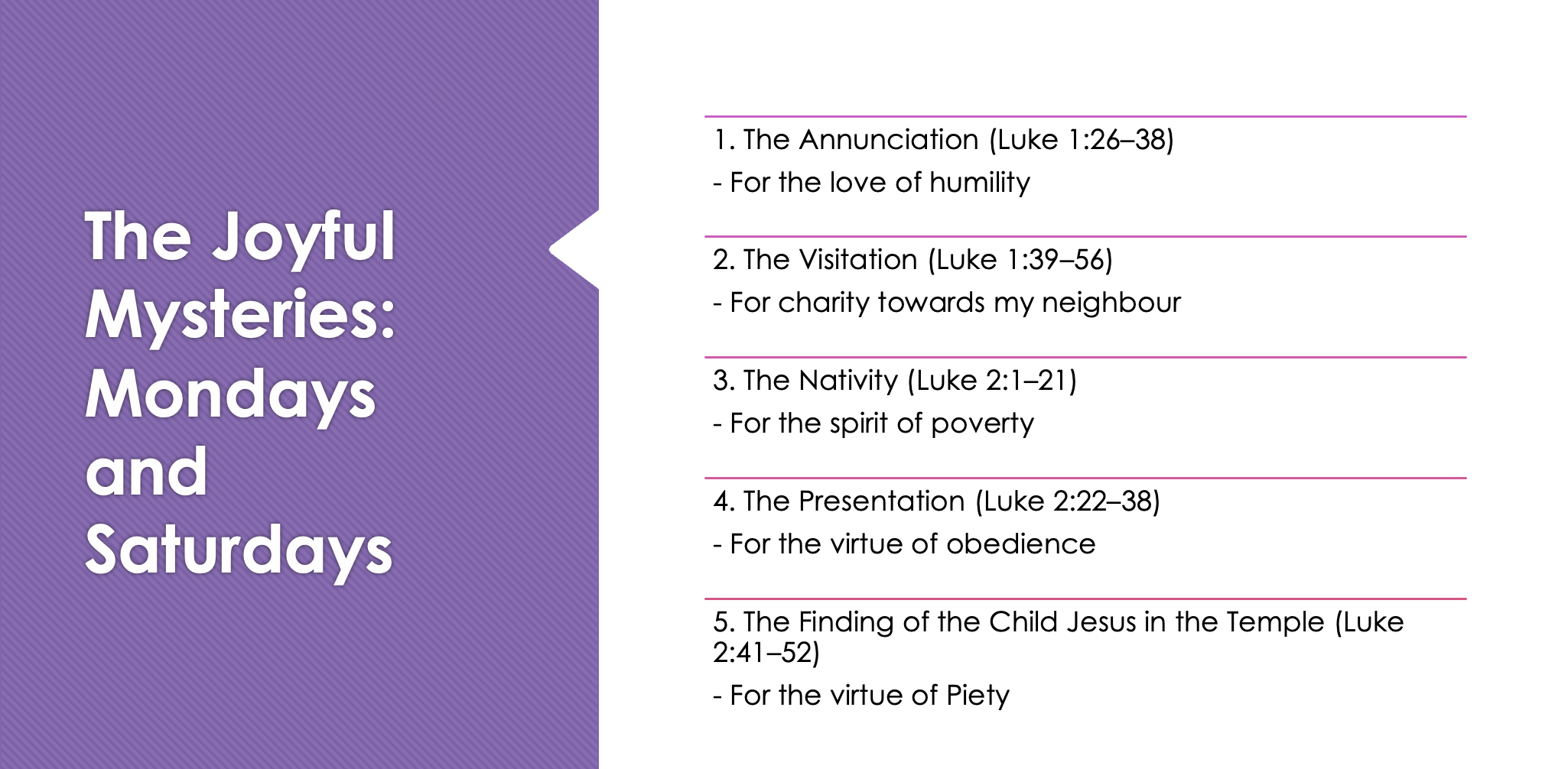
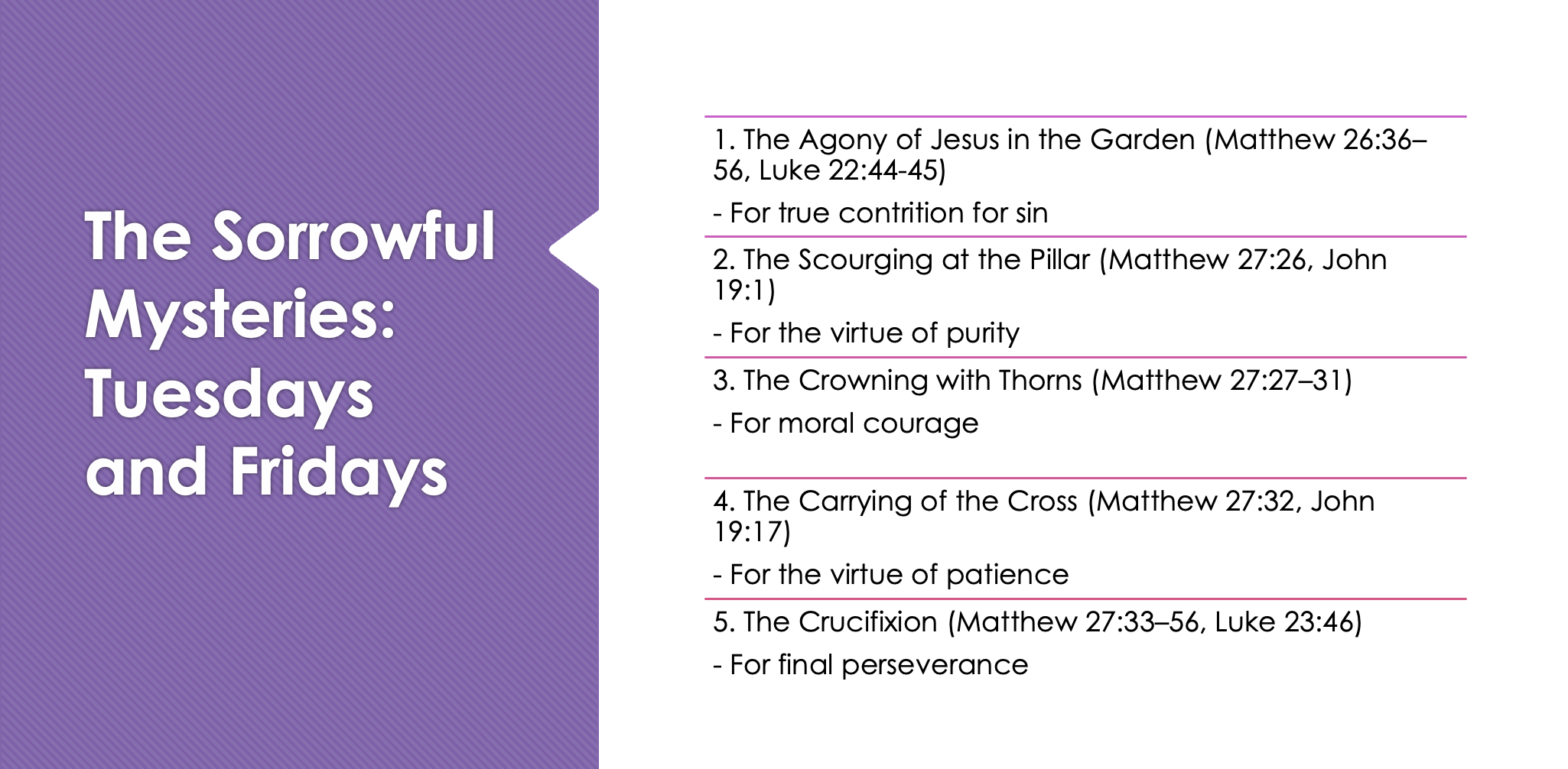
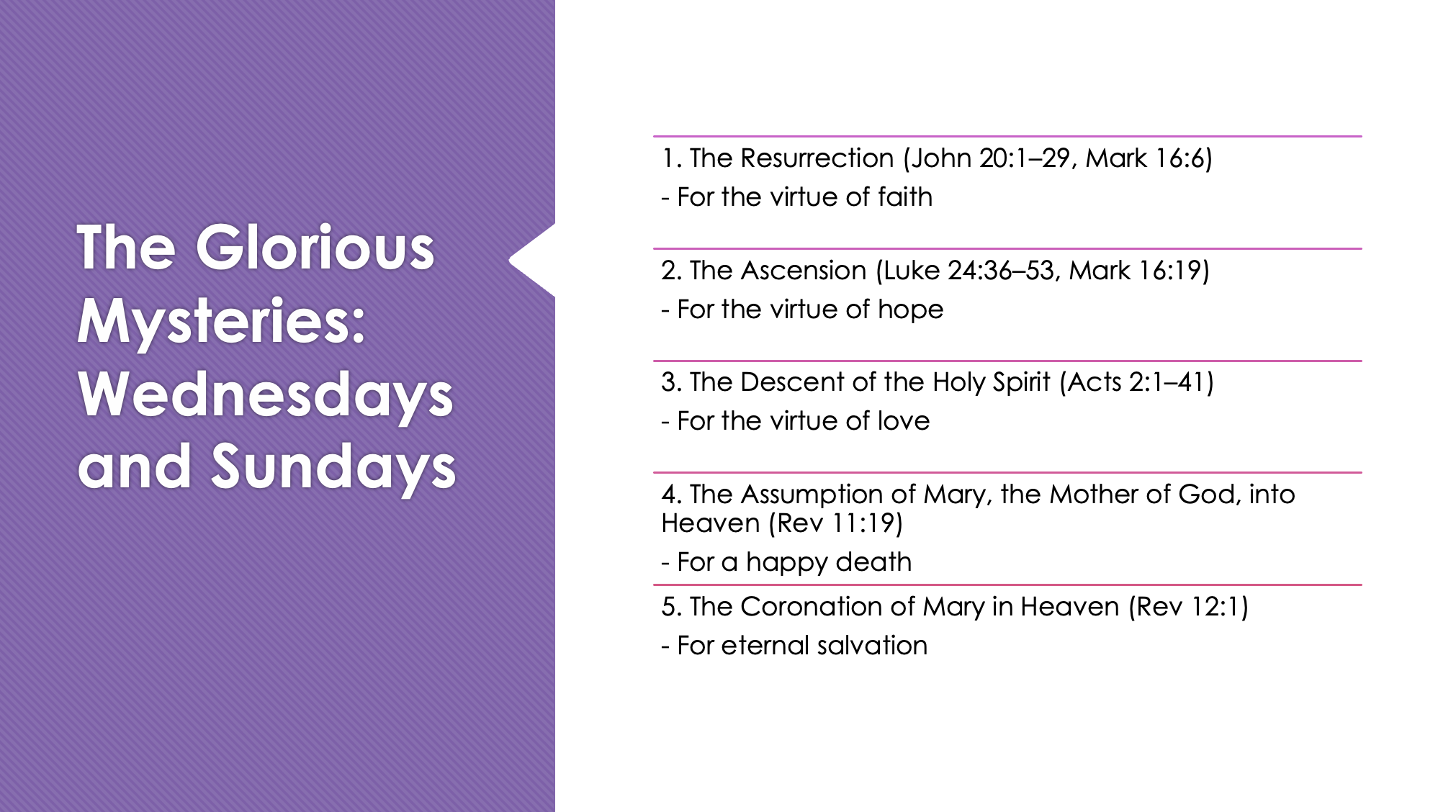
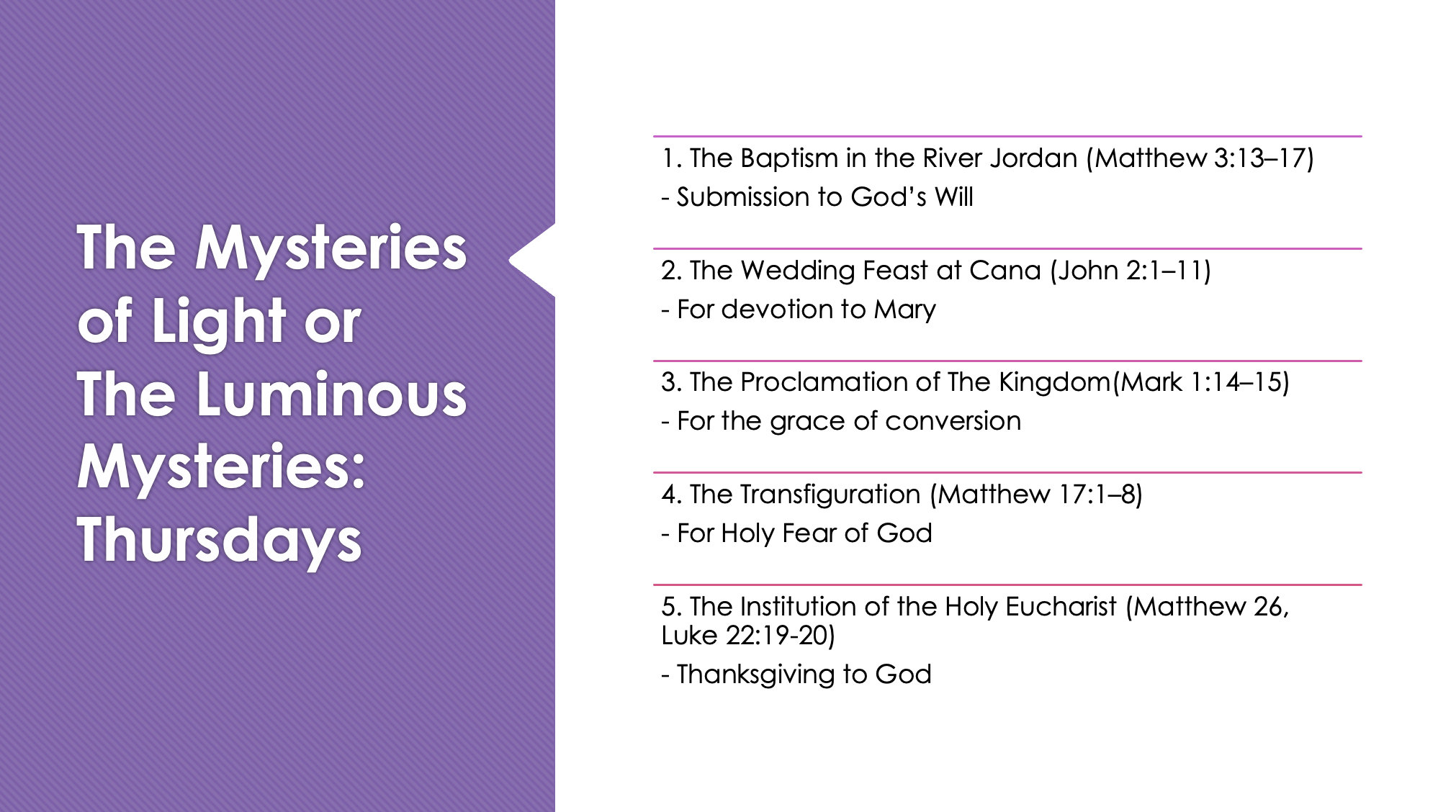
8. To begin the First Decade, announce the First Mystery, followed by a brief intention alone or a Bible Verse added. Followed by a meditation on the Mystery. Followed by The Our Father and The 10 Hail Marys and so on, OR the meditation can occur while you pray The Our Father and 10 Hail Marys.
For example, The First Joyful Mystery. The Annunciation. Followed by a brief intention alone (for the love of humility) or a Bible Verse could be added. Followed by a meditation on the Mystery. Followed by Our Father Who art in heaven…and so on.
OR, The First Joyful Mystery. The Annunciation. Followed by a brief intention alone or a Bible Verse could be added. Followed by Our Father Who art in heaven…and 10 Hail Marys, while meditating on the Mystery being prayed.
FYI: It is Gold Standard to always make an intention with each Decade, according to the book The Secret of The Rosary by St. Louis Marie de Montfort.
9. The Our Father is prayed on the centrepiece medallion, while the Ten Hail Marys are prayed on the next Ten Beads of the Decade.
10. On the Chain say Glory Be, followed by The Fatima Prayer, followed by the following:
Lead: Jesus have mercy on us.
Response: Mother Mary help us.
Lead: May the souls of all the faithful departed,
Response: Through the Mercy of God, rest in peace. Amen.
11. On the next Four Decades of the Rosary, repeat number 8 – 10. Remember to announce The Mystery before you begin praying the Second, Third, Fourth and Fifth Decade of The Rosary.
For example, The Second Joyful Mystery. The Visitation. Followed by what I mentioned earlier…Please refer back to #8.
12. Pray The Hail Holy Queen.
Hail Holy Queen:
Lead: Hail, Holy Queen,
Response: Mother of Mercy, Hail, our life, our sweetness, and our hope. To thee do we cry, poor banished children of Eve, to thee do we send up our sighs, mourning and weeping in this valley of tears. Turn then, most gracious advocate, thine eyes of mercy toward us; and after this our exile show unto us The Blessed Fruit of thy Womb Jesus, O clement, O loving, O sweet Virgin Mary. Amen.
13. Say the following prayers.
Lead: Pray for us, O Holy Mother of God.
Response: That we may be made worthy of the promises of Christ.
Lead: Let us pray
Response: O God, whose only Begotten Son, by His Life, Death, and Resurrection, has purchased for us the rewards of eternal salvation; grant we beseech Thee, that meditating upon these mysteries of the most Holy Rosary of the Blessed Virgin Mary, we may imitate what they contain and obtain what they promise. Through The Same Christ Our Lord. Amen.
14. Say the Litany of the Blessed Virgin Mary
Lead: Most Sacred Heart of Jesus
Response: Have mercy on us
Lead: Most Sorrowful and Immaculate Heart of Mary
Response: Pray for us
Lead: St. Joseph
Response: Pray for us
Lead: St. Louis Marie De Montfort
Response: Pray for us
Lead: St. John, the Evangelist
Response: Pray for us.
Lead: Litany of the Blessed Virgin Mary.
Lead: Lord, have mercy on us.
Response: Lord, have mercy on us.
Lead: Christ, have mercy on us.
Response: Christ, have mercy on us.
Lead: Lord, have mercy on us.
Response: Lord, have mercy on us.
Lead: Christ, hear us.
Response: Christ, graciously hear us.
Lead: God The Father of Heaven,
Response: Have mercy on us.
Lead: God The Son, Redeemer of the world,
Response: Have mercy on us.
Lead: God The Holy Spirit,
Response: Have mercy on us.
Lead: Holy Trinity, One God,
Response: Have mercy on us.
Lead: Holy Mary,
Response: pray for us.
Lead: Holy Mother of God,
Response: pray for us.
Lead: Holy Virgin of virgins,
Response: pray for us.
Lead: Mother of Christ,
Response: pray for us.
Lead: Mother of Divine Grace,
Response: pray for us
Lead: Mother most pure,
Response: pray for us.
Lead: Mother most chaste,
Response: pray for us.
Lead: Mother inviolate,
Response: pray for us.
Lead: Mother undefiled,
Response: pray for us.
Lead: Mother most amiable,
Response: pray for us.
Lead: Mother most admirable,
Response: pray for us.
Lead: Mother of Good Counsel,
Response: pray for us.
Lead: Mother of Our Creator,
Response: pray for us.
Lead: Mother of Our Saviour,
Response: pray for us.
Lead: Virgin most prudent,
Response: pray for us.
Lead: Virgin most venerable,
Response: pray for us.
Lead: Virgin most renowned,
Response: pray for us.
Lead: Virgin most powerful,
Response: pray for us.
Lead: Virgin most merciful,
Response: pray for us.
Lead: Virgin most faithful,
Response: pray for us.
Lead: Mirror of Justice,
Response: pray for us.
Lead: Seat of Wisdom,
Response: pray for us.
Lead: Cause of our joy,
Response: pray for us.
Lead: Spiritual vessel,
Response: pray for us.
Lead: Vessel of honour,
Response: pray for us.
Lead: Singular vessel of devotion,
Response: pray for us.
Lead: Mystical rose,
Response: pray for us.
Lead: Tower of David,
Response: pray for us.
Lead: Tower of ivory,
Response: pray for us.
Lead: House of gold,
Response: pray for us.
Lead: Ark of the Covenant,
Response: pray for us.
Lead: Gate of Heaven,
Response: pray for us.
Lead: Morning star,
Response: pray for us.
Lead: Health of the sick,
Response: pray for us.
Lead: Refuge of sinners,
Response: pray for us.
Lead: Comforter of the afflicted,
Response: pray for us.
Lead: Help of Christians,
Response: pray for us.
Lead: Queen of Angels,
Response: pray for us.
Lead: Queen of Patriarchs,
Response: pray for us.
Lead: Queen of Prophets,
Response: pray for us.
Lead: Queen of Apostles,
Response: pray for us.
Lead: Queen of Martyrs,
Response: pray for us.
Lead: Queen of Confessors,
Response: pray for us.
Lead: Queen of Virgins,
Response: pray for us.
Lead: Queen of All Saints,
Response: pray for us.
Lead: Queen conceived without original sin,
Response: pray for us.
Lead: Queen assumed into Heaven,
Response: pray for us.
Lead: Queen of the Most Holy Rosary,
Response: pray for us.
Lead: Queen of my family and loved ones
Response: Pray for us
Lead: Queen of all countries of the world
Response: Pray for us
Lead: Our Lady, Queen of Peace,
Response: pray for us.
Lead: Lamb of God, Who takes away the sins of the world,
Response: Spare us, O Lord.
Lead: Lamb of God, Who takes away the sins of the world,
Response: Graciously hear us, O Lord.
Lead: Lamb of God, Who takes away the sins of the world,
Response: Have mercy on us.
Lead: Pray for us, O Holy Mother of God,
Response: That we may be made worthy of the promises of Christ.
Lead: Let us pray.
Response: Grant, we beseech Thee, O Lord God, that we Thy Servants may enjoy perpetual health of mind and body and by the glorious intercession of the Blessed Mary, Ever Virgin, we may be delivered from present sorrow and attain eternal happiness. Through The Same Christ Our Lord. Amen.
15. Conclude The Rosary with the Sign of the Cross.
I would like to remind you that The Rosary is best prayed daily. I would also like to tell you of a consecration course to Jesus through Mary through the method of St. Louis Marie de Montfort! I urge you to look up the course provided by the Heralds of the Gospel on their Reconquest Platform. It is a solid 33-day course. It is a solid investment that will never suffer loss for all eternity.
Thank you for reading today’s post. God bless you, in Jesus’ Name. Amen. Mother Mary, please help us. Amen.
Let it be or “Ka ọ dị” as it is said in Igbo.
Latest from KATMIRA’s Blog
-
How To Pray The Rosary
Introduction to the Rosary “The Rosary is a Scripture-based prayer. It begins with the Apostles’ Creed, which summarizes the great mysteries of the Catholic faith. The Our Father, which introduces each mystery, is from the Gospels. The first part of the Hail Mary is the Angel’s words announcing Christ’s birth and Elizabeth’s greeting to Mary.… Read more

