

Marriage

By Cynthia Aralu

Hi everyone, I hope you’re all doing well and remembering to pray the rosary.

Recently, I’ve taken some time to learn more about the concept of marriage as understood by the Catholic Church, so as to guide me. I vaguely recall listening to a priest on a podcast, a while ago, where he addressed a question about attending a wedding that would not take place in a Catholic Church (if I remember correctly). His response was, “No, a catholic should not attend that wedding”. This discussion stood out to me, and I stored it away in my mind.

I also remember a debate from when I was much younger about whether Catholics who completed the Nigerian traditional marriage were considered already married. Someone argued that they should be, since the traditional marriage existed long before Christianity arrived. I can’t recall my exact viewpoint during that conversation—it might have been in favor of the “White” wedding (Catholic wedding), against it, or simply confused by the complexity of the topic. At the time, I hadn’t received sufficient catechesis to be fully educated on the matter.

More recently, about a year or two ago, I had an awkward conversation with someone who had completed a “traditional Nigerian marriage”. During the discussion, I explained that, according to the Church, the individual wasn’t truly married yet and encouraged them to avoid sin before the Catholic marriage was finalized. Looking back, I realize that I must have understood that a traditional marriage wasn’t considered valid at all. However, I wasn’t entirely clear on all the reasons why. I only knew it was not and that it was my responsibility to offer advice, regardless of whether it was accepted.

Recently, despite my initial reluctance, I’ve delved into Canon Law to gain clarity. In addition to studying the law, I’ve spent time watching numerous videos, reading Catholic materials, and engaging in conversations about this topic. Although I often feel unsure and exhausted, I’ve tried my best to understand. This journey has led me to much greater clarity than I ever had before—and ultimately, it has guided me toward conversion.

First of all, baptized Catholics are governed by Canon law. This might not be widely understood by many Catholics, and I’ll admit, it was something I personally struggled to make sense of. When I think of “government,” I often associate it with countries. The idea of being governed by Canon law felt strange at first. However, upon reflection, it makes sense: I am a citizen of Heaven and the government of Heaven has a physical/visible representative here on Earth—the Church. Any discomfort or unease I feel or have felt about this authority likely stems from my own struggles with submitting to authority, not from the authority itself being invalid.

Canon law provides a framework rooted in divine law and tradition, and disobedience to it is considered immoral or sinful. While I’m not the person to determine the severity of sin for anyone (frankly struggle even for myself), I encourage studying more about the nature of sin and the three key elements that distinguish venial sins from mortal ones: grave matter, full knowledge, and deliberate consent.

As such, with regards to marriage, the Church governs the marriages of Catholics. For Catholics, marriage is a sacrament that requires adherence to Canon law for both validity and sacramentality. Canon law lays out clear guidelines regarding the sacrament of marriage, and its validity depends on meeting specific requirements, i.e. a celebration of marriage according to canonical form, including:

  • Celebration of the marriage in the presence of an authorized Catholic cleric and at least two witnesses, typically in a Catholic church, unless a dispensation is granted.
  • Celebration of the marriage according to liturgical practices established by the Church.

If a Catholic marries outside of canonical form—such as through a civil ceremony or in a non-Catholic setting without proper permissions—the marriage is considered invalid unless a bishop grants a dispensation.

In addition, when a Catholic and a non-Catholic wish to marry, they must meet the requirements set out in canon law (including the permission of the local ordinary). Without this dispensation, the marriage is deemed invalid and cannot impart sacramental grace, even if one or both parties are baptized.

Baptism is essential for sacramentality, but it’s not the only requirement. Other necessary elements include the intention to remain faithful, openness to procreation, freedom/capacity to marry, free consent, and adherence to the proper form of marriage—including the presence of an authorized cleric and witnesses.

Additionally, Canon law requires a Catholic who was previously married to obtain an annulment of their prior marriage before entering into a new one, even if the previous marriage was civil and deemed invalid. This ensures the sacramental integrity of the new marriage.

Invalid marriages can be healed by the Catholic Church, as appropriate for each case in order to bring the marriage into conformity with Church teaching and allow it to be recognized as valid. It highlights the pastoral care of the Church and its desire to guide the faithful back into good standing with the Church and God, all while considering the unique needs of each case.

It’s important to note that these guidelines apply specifically to members of the Catholic Church and doesn’t extend to non-Catholics. If you’re interested, I recommend exploring Canon law further for more information.

From my brief investigation, I have learned that attending an invalid marriage can be considered immoral, depending on the circumstances. Some adopt a firm stance, refusing to attend any invalid marriages, while others take a more flexible approach, evaluating each situation on a case-by-case basis—for example, when a marriage takes place outside the Catholic Church without a bishop’s dispensation. When it comes to unions that could involve adultery, I’ve encountered advice urging extreme caution. One perspective suggested that the morality of attending such a marriage might only become clear at the final judgment—a thought that sent a literal chill through me. However, there is a clear and consistent teaching to take a firm and resolute stand against attending same-sex marriages.

When a marriage is invalid, any immoral actions within such a union are sinful. There is also the argument that the marriage itself is immoral because it involves a violation of Canon law. This raises questions for me, particularly about the stance of the Nigerian Catholic Church. I wonder why traditional marriages often take place before Catholic church marriages if they are recognized as immoral. Is there some sort of dispensation granted in these cases? This has been a source of confusion for me, as well as for others who see no issue with civil or traditional marriages occurring before the Catholic wedding as a result of this. It is entirely possible that such practices are sinful yet have become normalized to the extent that it is now seen as good, and that is a difficult reality for me to fully grasp.

All of this feels too complex for my simple mind. My intuition is to avoid these situations altogether—or at least consider those that have the potential to become licit, where there is a clear intention to complete a Catholic marriage afterward (with a set date and plans in place). However, I recognize that I might be influenced in allowing this small exception by my background and the advice from priests I’ve come across. Is it good? I have different thoughts, and I can’t say for certain. Scandal doesn’t just affect those directly involved; its repercussions can ripple through generations. This is where my mind lingers. When I consider that, I believe avoidance is often the wisest choice, as you can never truly know if your intended good might come at a hidden cost. Ultimately, my priority is to put God first.

I don’t know enough to speak in depth about customary marriages (nigerian traditional marriage) or how the Catholic Church in Nigeria provides pre-marital counselling regarding the navigation of traditional and Catholic marriage. Typically, the traditional marriage is completed first to satisfy the cultural practice of giving a child away, and all weddings (traditional, civil, church) are often planned together and usually take place within a short time (hours, day(s) or month(s)) of each other. From what I’ve read briefly, customary marriages are legally binding under Nigerian law. I’m also aware that some Catholics consider customary marriages to be valid. Unfortunately, Nigerian Catholics can easily fall into sin if they are misled, poorly taught, or influenced negatively by culture or scandal. This is why, when I was much younger, I was in a discussion with fellow Catholics about whether customary marriage alone is sufficient. Personally, I am starting to think the traditional marriage may not be necessary for me but we’ll see since culture is beautiful to have in one’s life but never at the expense of faith and morals.

It shouldn’t come as a surprise to any Catholic that I wholeheartedly believe in the truths revealed by the Catholic Church in Canon law and the precepts of the Church, or that as a result, I decide to live my life through the lens of the truths revealed by the Catholic Church, to the best of my ability and I do not intend to reject any truths revealed by the Catholic church, all by the grace of God and the moulding hands of Mother Mary. I can understand a non-Catholic disagreeing with me. However, when the disagreement comes from a fellow Catholic, it fills me with a sense of relational dissonance, loneliness, exhaustion, uncertainty, and a deep longing for God.

On a final note, pray the Rosary!

Thank you for reading today’s post. Remember to like this post and share it with your friends if you enjoyed it. Follow me on my blog, Katmira’s blog, to receive notifications whenever I have a new post. You can also subscribe below to get an email notification whenever a new post is out. This is particularly helpful if you don’t have a WordPress account.

Let it be, until we meet again or “Ka ọ dị” as it is said in Igbo.

Note: Co-pilot was used to refine this write up and also garner some information.
A lovely song to listen to!

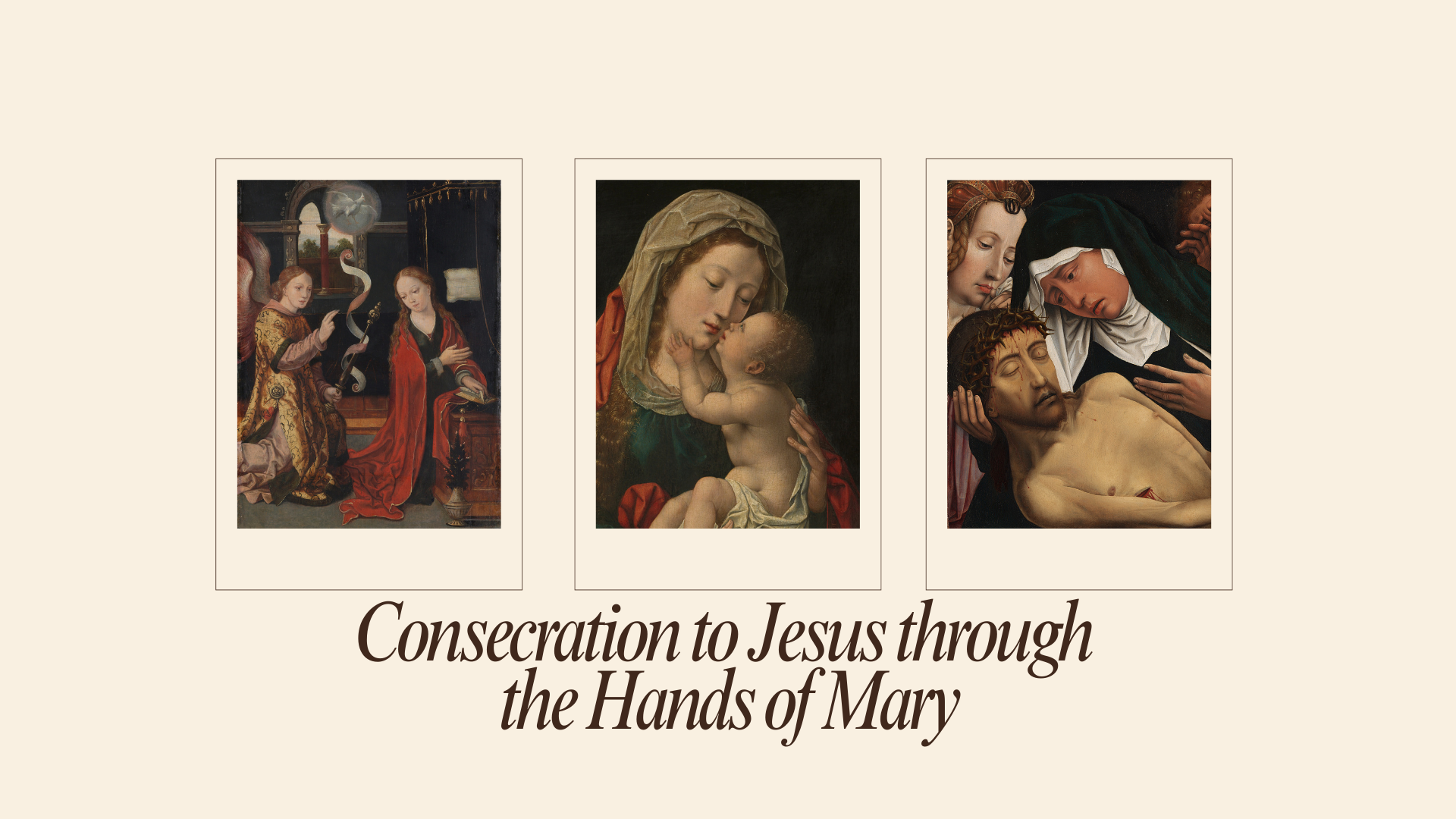
Consecration to Jesus through the Hands of Mary

By Cynthia Aralu

Hello everyone! I hope you are all doing well and you remember to pray the rosary.

For quite a while now, I’ve felt as though I have nothing meaningful to share—like I have no voice. Whenever I wanted to express something, it always seemed like the timing was off, or my words came across as too harsh and unrefined. With that in mind, I could offer you a glimpse into my current thoughts and direct you to a consecration course to Jesus through the hands of Mary.

1. The concept of “unconditional love,” as it is often interpreted to mean, that is, the enabling of evil for the sake of love, is a distortion. Reflecting on the verse, “For God so loved the world that He gave His only begotten Son, that whoever believes in Him shall not perish but have everlasting life.”, we see that God, who is Love, has demonstrated the depth of His love for the world. Yet, He also made clear that only those who believe in His Son, sent as a perfect sacrifice, will have eternal life.

This highlights that holy love—the highest and purest form of love—maintains boundaries while remaining enduring, as mercy itself is an expression of love. You are loved as you are, but called and nurtured to be the best. This is the true definition of unconditional love. Any love that strays from or fails to align with God’s Holy Love becomes an aberration, no longer love but a corruption of the term. I believe this is reason people do not believe in love or the transformative power of love. They have imagined in their heads what love is not and defined it as love and their imaginations have failed them.

2. The world and its people are steeped in corruption—a truth that should not come as a surprise. I felt the weight of this truth profoundly last year when I renewed my consecration to Jesus through the Hands of Mary. I do not exclude myself from this observation. It is difficult to truly grasp the depth of corruption embedded in the mind of someone who has lived an unguarded life, shaped and influenced by evil perspectives. Recently, this feeling has grown remarkably intense.

Consider this: “Mary is the supreme masterpiece of Almighty God and He has reserved the knowledge and possession of her for Himself”. Yet “Mary being a mere creature fashioned by the hands of God is, compared to his infinite majesty, less than an atom, or rather is simply nothing, since He alone can say, ‘I am He who is'”. Mary herself knew and believed this truth, proclaiming, “I am the handmaid/slave of God… He has regarded the low estate of His handmaiden… He has put down the mighty from their thrones and exalted those of low degree”.

Reflect further: “God the Father gave his only Son to the world only through Mary. Whatever desires the patriarchs may have cherished, whatever entreaties the prophets and saints of the Old Law may have had for 4,000 years to obtain that treasure, it was Mary alone who merited it and found grace before God by the power of her prayers and the perfection of her virtues. “The world being unworthy,” said Saint Augustine, “to receive the Son of God directly from the hands of the Father, He gave His Son to Mary for the world to receive Him from her.” The Son of God became man for our salvation but only in Mary and through Mary. God the Holy Spirit formed Jesus Christ in Mary but only after having asked her consent through one of the chief ministers of His court.” See “Treatise on True Devotion to the Blessed Virgin”, by St. Louis Marie Grignion de Montfort

Now considering that Mary is esteemed greatly but is nothing in comparison with God, and her merits far surpass those of the saints in Heaven—who are themselves esteemed to the extent of their merits—by this true measure, I recognize how wretched I am.

3. Since “Mary loves Jesus ardently and glorifies Him more perfectly than all of God’s other creatures—saints and angels alike”, it follows that honoring Mary and the saints brings honor and glory to God. In the same vein, all creation, whether in heaven, on earth, under the earth, or in the sea, rightly gives God praise. Who could do this more perfectly when praised and honored than Mary and the saints in Heaven? Consider Mary: when praised by her cousin St. Elizabeth, her immediate response was a song of praise to God, proclaiming, “My soul glorifies the Lord, and my spirit rejoices in God my Savior…” This truth should be as evident as when one gives charity to the less fortunate and brings glory and praise to God—whether through the grateful lips of those helped, the hearts of those who witness or learn of the event, or by the charitable deed itself inspired by God. Similarly, when the saints in heaven are honored, they give glory of God as a sort of reflection, having been conformed to Him to the extent they have merited. See “Treatise on True Devotion to the Blessed Virgin”, by St. Louis Marie Grignion de Montfort

4. There is a noticeable inconsistency between truly serving God and what some individuals, who believe they are serving Him, deem acceptable—such as reading books or watching movies with pornographic content in their homes. This is just one example, yet it has become so normalized for some that their conscience has grown desensitized. They may believe their conscience is clear, even when confronted with this truth from an external observer.

5. It is inconsistent to claim to “believe and follow all the teachings of the Catholic Church” while accepting or engaging in certain practices that contradict its teachings. Allow me to list a few examples: being complacent about your children leaving the Catholic Church, speaking about confession as though it is optional, speaking negatively about devotion to the saints, accepting the use of contraception, abusing the sanctity of the marital bed, or considering IVF as an acceptable option.

A recent instance that left me unsettled involves the engagement with content where someone, under the label of ‘Christian prophecy’, examined palms to predict the future. I have been cautious in describing the activity as it was relayed to me, refraining from attaching specific labels to it. However, I was informed that it is not considered divination or palm reading—or that palm reading, in this context, is not divination—but I struggle to see how the conclusion could be otherwise, even if it is rare in its occurrence, as I’ve been told. I believe the truth will come out one day.

Ironically, it would be better to follow all the teachings of the Catholic Church in simplicity, even without raising “wise questions” or trying to be wise in one’s own eyes, as such simplicity in faith could make one truly wise.

6. There is no greater mother than Mary. Even if I falter, I trust her to guide me back to true contrition and repentance. I rely on her to show me the best way to please her Son, Jesus, who, in His love, has chosen to be my brother. This was once a source of concern for me, but through the consecration course, I learned to entrust myself to her care. Now, I feel a deep sense of peace, knowing that she intercedes for me before Jesus.

7. Why go to Jesus through Mary? It pleases Jesus, as it is the most perfect way He chose to come to us, and thus the most perfect way for us to go to Him. Furthermore, since Jesus is God, just as God the Father is God, and we have been given Jesus Christ as a Mediator between us and the Father, it is fitting that Jesus, being God, would also have a mediator. Out of His profound humility and perfection, He gave us Mary—not out of necessity, but because it is the most humble and perfect way He chose to unite Himself with humanity in the flesh; through her.

Humility is not easy, and in today’s world, its meaning has been lost. Many have also lost a sense of a Holy Fear of God, to the point where roles and stations are no longer given their due regard. I personally grapple with the concept of humility, as it feels foreign to me. Yet, in Heaven, hierarchies exist as part of God’s divine order.

8. There is a consecration course set to begin on March 24th, led by the Heralds of the gospel. I will renew my consecration to Jesus again this year by God’s grace.

“The Consecration Course is based on the Treatise on True Devotion to the Blessed Virgin, by St. Louis Marie Grignion de Montfort, a prophetic work and a theological document of the utmost importance. A daily video lesson will be on Heralds of the Gospel’s online catholic course platform (“Reconquest Platform“)”. 

  • “The first class, on the evening of the 24th of march, will be a Live on Youtube at https://live.heralds.org/
    On consequent days, you will be able to attend each day’s class at your convenience. The classes will be recorded and will be available from 5 a.m. 
  • To easily receive all the information, you can join their WhatsApp group – although this is not necessary: click here.
  • Send any questions you have to: consecration@heralds.org
  • To join the consecration course, sign up at this link: https://consecration.heralds.org/slei
  • Alternatively, if you are wary of links, google “Reconquest Platform Heralds of the Gospel”. It should be easy enough to navigate to the free consecration course that starts on March 24th and ends on April 26th.

Here is an another excerpt from the True Devotion to Mary: Consequently, this great Lord, who is ever independent and self-sufficient, never had and does not now have any absolute need of the Blessed Virgin for the accomplishment of His will and the manifestation of His glory. To do all things He has only to will them. 15. However, I declare that, considering things as they are, because God has decided to begin and accomplish His greatest works through the Blessed Virgin ever since He created her, we can safely believe that He will not change His plan in the time to come, for He is God and therefore does not change in His thoughts or His way of acting.

On a final note, pray the Rosary!

Thank you for reading today’s post. Remember to like this post and share it with your friends if you enjoyed it. Follow me on my blog, Katmira’s blog, to receive notifications whenever I have a new post. You can also subscribe below to get an email notification whenever a new post is out. This is particularly helpful if you don’t have a WordPress account.

Let it be, until we meet again or “Ka ọ dị” as it is said in Igbo.

Note: Co-pilot was used to refine this write up.