For An Increase in Faith

By Cynthia Aralu

Hello everyone. Remember to pray the Rosary!

I suppose I should say Happy New Year, or rather, Merry Christmas and a Happy New Year to you all. The future feels overwhelmingly long, so I’m choosing to follow Jesus’ words and focus on today, because each day has enough worries of its own. I’m thankful to God for His forgiveness, for helping me to keep praying, for holding me close, and for never letting me go. I’m aware of how often I fall short in loving Him as I should. It is a source of unhealthy grief and I don’t believe it helps me, however, my knowledge of what helps me is limited, so there is a chance that even in this conclusion, I am wrong. Since, in all things, God works for good, for those who love Him. Life moves so quickly, so I’m trying to take things slower and to be at peace with the things I cannot control.

I wrote most of this post, perhaps on the first week of last December, but never got around to sharing it. I’m glad I finally am.

This is a post about faith. It feels connected with a recent encounter I had with a man on a plane on the eve of Christmas, who’d introduced himself as Anglican, whom I’d come to realise was lacking in faith, love and perhaps, hope. I was moved to pray for him and his family, and as well for an increase in faith in myself; not that the encounter led me to doubt but because I know I am not infallible. After this prayer, I soon realized that I too, through a lack of knowledge and unaddressed doubt or should I say “confusion”, was lacking in faith. It was ugly but thanks to God, it did not last, because it is the very nature of faith to carry on even when knowledge lags behind, and I am grateful for the ministry of reconciliation. So here I am, praying that Jesus saves me from this body of death. Thanks be to God, for He has loved me enough to show me, so I know His work is not finished yet.

To have faith when you have been let down over and over again is not an easy thing to do. I don’t think I was always skeptical. I think it became my defense mechanism against the lies I was always so gullible to believe growing up, lies that did not even make sense. I believe it played a role in me falling out of faith when I became much older, although I cannot say it was the only reason. In a world full of deception, selfishness, cruelty, disregard for life and limitations, it is better to put your faith in God, who is Truth, Love, Life and Unchanging, than to put your faith in man.

The bible says, “Faith is the assurance of things hoped for. The conviction of things not seen”. I recall writing a post about the point of life a little close to five years ago, April 4, 2021, to be exact (as seen in my notes). This was at a time I had returned back to a belief in God, as more of a unshakable conviction than a logical conclusion. I must add that no matter what logical conclusion one has, without a conviction, one is not able to come to faith, because not everything is seen or known, no matter how smart the argument sounds for the existence of God; this is because we are quite foolish after all, and the wisdom of men is foolishness to God. Once one has faith, all other argument contrary to the existence of God, or suggestions that it is impossible to know, becomes utter foolishness and is rejected with a vim, “God forbid”. This is because it is the character of faith to know, with a conviction reverberating throughout your very being, without knowing everything.

In any case, I read my writing from years ago and it seemed bizarre to me. I am also uncertain in totality what I believed in, since I did not see any point of life back then, even after believing in God. From reading my writing, I can only conclude that I lacked hope. I also lacked the things which people would typically state as the point of life, and what I did have, was so distant, that I could not latch on to the idea of it. From a place of poverty, I’d set out to write out my thoughts in order to prove that there was no meaning to life, however, by God’s providence, I ended up proving to myself, logically, that God exists.

I argued back then that the actual search for a point to life is futile because if life did not exist, there would be no search for its meaning. To my mind back then, the idea of a point to life only stemmed from life’s existence so, it was inaccurate for people to say helping others is in essence what gives life meaning, because the point to life could not stem from the actions of the people existing. I believed life’s point had to exist outside of life and demand that life functions in the way it was created to function. And so, if we were to ascribe to life, an External Creator who determines life’s function, then, the Creator’s Will becomes the point of life. The rest of my writing went quite dark and ended with me saying life seemed pretty pointless.

Back then, I held up 2 possibilities if we were to consider an External Creator. The first possibility was that humans are high functioning beings with wants and desires. As a result, the need for choice could not be escaped because of that very design. However, if the idea of the Creator’s Will being the point of life is the standard, this idea strips an individual of the individual’s will, leaving that individual a shell waiting to be commanded and nothing more. Just like a remote control cannot argue about the reason for its existence. The second possibility was that it is the Creator’s Will that we exist exactly as we have been created, complex and different, free to make our decisions and chase our desires, (I believe I thought this was as long as it did not go against The Creator’s Will, although I cannot be certain of this addition as I have inserted it as I’m writing this, and I distrust my memory), and when we can no more, to die, in a natural process or circle of life. When I considered that, I concluded that the point to life could possibly be defined as the sum of all we amount to or our fate in life. I considered how unfair and uncertain fate is and decided that life seemed pretty pointless. I believed people confused the point to life with what I termed “anchors to life” or reasons for living, such as family, love, friendship etc. I considered that perhaps there was more out there, a world that we are unaware of, but even if we gained all of that knowledge, it would not really matter or change the situation of the world. The way I saw it, I was lucky to have my family, and if that luck persevered, maybe I would have the love I desired. So, for one who’d thought I’d come back to Christ, I had come to a worldly conclusion.

I have come to a third possibility, I believe through God’s providence, which builds on truth within the first and the second possibilities, which I believe is true: If life did not exist, there would be no search for its meaning. The idea that there is a point to life only stems from the very fact that life exists. The point of life cannot be derived from the actions of the people existing as a primary principle, since if life did not exist, there will be no search for its meaning. Life’s point has to exist outside of life and demand that life functions in the way it was created to function. So, we can consider the Force or Power that exists outside of life and demands that life functions the way it has been created, an Immortal Creator (God), able to drive life in the direction He pleases. We can deduce from how precise and intricate creation is that there are no accidents and as such, there must be a clear plan for creation. In our human understanding, we would call a device that fails to do what it was created to do, “faulty”. However if the creator of a device dies, the device does not lose the meaning for its creation and if not faulty, is able to continue existing after its creator is dead. Without God, we would have no meaning since everything will cease to exist. From this point of view of our existence in relationship with God, it suggests that God is the Uncreated Primary Cause, and His creation are created secondary causes.

Humans have been created to be high functioning and complex, having wants and desires, the ability to search out the meaning of its creation, and to participate in it as a driving force. This reveals God’s desire that we have our own will, in order that we choose. However, since God is Creator, He has designed us to exist in the manner we have been created to exist. In order for creation to be, there has to be God’s Design and God’s Law for His creation, which humans participate in as a driving force. It follows that choosing God’s Will keeps us in God’s design, but rejecting God’s Will, throws us out of God’s design for us. To be able to choose at all God’s Will or to reject God’s Will, we would need to know what God’s Will is. This need we have to know of God and His desires, reveals that there is a type of relationship that God desires with humans.

In addition, when one considers that an all-powerful God created the universe, desired humans to know Him, and gave us the free will to choose; I suppose this gives evidence of the nature of God, which is Pure Love, because given the choice, humans can love you or hate you. God chose that vulnerability. God being Love itself, did not force us to love Him out of compulsion even if it meant we could reject Him. This reveals another nature of Love. Love is not driven by the need of one party over the detriment of the other party. So, The Creator has to be a God infinitely more powerful than we can imagine to create the universe, and irrevocably Love to have created us.

It could not be a sadistic situation either for human beings to choose God’s will, given that when one reaches discernment of what love is, we know that Love is pure, Love is good, Love is truth, Love is life, Love wills the best for you, Love is joyful, Love never ends. I can conclude from the nature of love that in living according to God’s will, humans were joyful and full of life at some point. If you consider our current human experience, you will see evidence of a lack of joy, a lack of truth and an abundance of death because of lies, selfishness, cruelty and a disregard for life. It is possible to discern that something must have happened to us to bring about this change from love, joy and life, to what it is now. Something that took us away from God’s will for us. Something that made us broken.

If you look into all the stories in the world which speak of God, none of them relates the nature of God from the point of view of God creating us, in a way that gives a snapshot of God’s Power, Love, Vulnerability, Care, Purity and Loving Relationship with created things, like the God of the Bible does. Nothing else fits.

The Bible, in Genesis explains that our first parents (Adam and Eve) went against God’s will. As a result of this, sin and death came into world, and today we suffer the consequence of those actions. In essence, all the evil, sickness, death and bad that you see in this world is a consequence of sin. The Old testament tells a story of a God who loved the world so much, He set a plan in motion the moment humans sinned and fell away from His Design, in order to save them, because He is a God that does not rejoice in the death of the wicked. In His Divine Plan, He set apart a people for Himself (Israel) through whom He gave the world a Divine Law (The Ten Commandments).

The problem with sin is that it corrupts everything, and one of those things corrupted is the human intellect and the human will. As a result, after the fall, humans did whatever they felt was right in their eyes, which did not necessarily mean it was good, because on the one hand, humans enjoy sinning, and on the other hand, it can sometimes be hard to discern because of the darkened intellect, and also, we do the things that we do not want to do because of a weakened will. God knew the people He set apart for Himself were imperfect, unable to keep the Law, but it was necessary to give the Law so that what is sin may be revealed through the transgression of His Law, so that we come to knowledge of the gravity of sin which is death, so that God’s Justice and Mercy is magnified and so that humans stop destroying themselves and others. We are like foolish toddlers set on killing ourselves through our interaction with the world around us.

Through the Law and the Prophets God provided, He prepared a people for the coming of the Perfect Sacrifice to take away the sin of the world, Jesus Christ. And through the perfect everlasting sacrifice of Jesus Christ, His Son, in the likeness of sinful man, sin was condemned in the flesh. If sin is not condemned, God is not Just, but if there is no mercy, God is not merciful. This is why Christ’s sacrifice is the One Perfect Sacrifice. Jesus received the justice for our sins. Hence, those who have died in the flesh with Christ and now have new life through Christ’s resurrection, have their sins washed away, a regeneration of a new heart and have received an outpouring of the Spirit of God; the Spirit of adoption as heirs of God, being co-heirs with Jesus Christ.

What great love God has for us that while we were still sinners, He sent His Son into the world knowing that He would be killed by humans because the world hates all that is Good, Pure and Holy. Through Jesus’ entry into the world, we see that suffering is an inescapable part of existing in a broken world, but there is dignity and purpose in suffering well, when united with Jesus’ suffering. Through Jesus’ obedience and His sacrifice, God lifted Him up and gave Him a name that is above any other name. So, we know with a knowing that is conviction, a gift from God, that if we live through Him, In Him and With Him, we have the justification of a clean conscience before God, a crown of glory and immortality in God’s presence, where there is fullness of life and peace.

From this third possibility, I can see in fact, that the point of life is relationship with God, and from what I have come to know and believe, I can see that this relationship can only be through Jesus Christ, His Son.

Relationship does not negate religion. It is through the system of religion which Jesus Himself instituted, in establishing His Church, through Peter, “the rock”, and supported by the Apostles, the pillars of the Catholic Church, in a succession that spans nearly two (2) millennia, that we are able to have a relationship with God through Jesus.

The bible points out religious practices which are pleasing to God and those that are not. It never said religion is bad. So, if you’ve heard religion is bad, do a complete 180 and drop such foolish beliefs and doubt the ones or groups that told you that. There might be no malice from them but there is plenty foolishness and a blind man cannot lead a blind man. To accept such a teaching signals a spirit that craves sugary goodness without the pain of submission to authority and yes, there is pain that comes with submission. You are not able to reach pure love of God there or anywhere else other than the Church Jesus founded, which is the ONE, Holy, Catholic and Apostolic Church. That is, if this is your desire.

Old testament:

  • Is not this the fast that I choose: to loose the bonds of wickedness, to undo the thongs of the yoke, to let the oppressed go free, and to break every yoke? Is it not to share your bread with the hungry, and bring the homeless poor into your house; when you see the naked, to cover him, and not to hide yourself from your own flesh?

New testament:

  • Jesus speaking: And I tell you, you are Peter, and on this rock I will build my church (singular), and the powers of death shall not prevail against it.
  • If any one thinks he is religious, and does not bridle his tongue but deceives his heart, this man’s religion is vain. Religion that is pure and undefiled before God and the Father is this: to visit orphans and widows in their affliction, and to keep oneself unstained from the world.

On a final note, pray the Rosary!

Thank you for reading today’s post. Remember to like this post and share it with your friends if you enjoyed it. Follow me on my blog, Katmira’s blog, to receive notifications whenever I have a new post. You can also subscribe below to get an email notification whenever a new post is out. This is particularly helpful if you don’t have a WordPress account.

Let it be, until we meet again or “Ka ọ dị” as it is said in Igbo.

Note: Co-pilot was used as an editing tool.

A great song to listen to!

Discernment

By Cynthia Aralu

Hello everyone! Remember to pray the Rosary!

Discernment is a gift from God, and this gift will save you from being in horrible situations. How are we to know who to listen to? How are we to know what is good?

We hear Jesus say in the Bible that, “The good man out of the good treasure of his heart produces good, and the evil man out of his evil treasure produces evil; for out of the abundance of the heart his mouth speaks.“.

In another passage, Jesus says this: “Beware of false prophets, who come to you in sheep’s clothing but inwardly are ravenous wolves. You will know them by their fruits. Are grapes gathered from thorns, or figs from thistles? So, every sound tree bears good fruit, but the bad tree bears evil fruit. A sound tree cannot bear evil fruit, nor can a bad tree bear good fruit. Every tree that does not bear good fruit is cut down and thrown into the fire. Thus you will know them by their fruits.

From Jesus’ words, I can only discern that Jesus cautions me to be careful about people who come to me in His Name and that I am to look to the words spoken by these people and their actions to discern what is in their hearts. Such caution, I will also apply to myself in discerning my heart, for it is necessary that I know myself, so that I too may come to repentance.

In my encounter with the content of a Catholic association whose content I follow and engage with, and in learning about the scandal that surrounds them, I have been given the opportunity by God to learn how to apply such caution, without an active awareness I was doing so. The Catholic organisation taught me and imparted so much good. I do not recall whether I learned of the scandals during the first period of being taught by them or after; I remain uncertain. Yet I found it difficult to believe they were the evil spoken of, even though I could not be sure and at times felt suspicion because of the scandal, to my shame and repentance. There are certain practices of theirs that I believe would serve them well not to continue, though none are inherently evil, and as well, my assessment of what might serve them could be wrong. The richness of the good that has come from their mouths, combined with the impression I have that they seem not to have been touched by evil or darkness has deeply influenced me to believe they are good (though perhaps this is only evidence that Jesus has transformed them so profoundly that their senses reflect this, without this being the truth of their life experiences).

I asked Mary whether they are good, and I believe I prayed for the vindication of their founder if he was indeed a good man, though my memory is not entirely clear. Even after discovering the past scandals, I did not stop watching them. I wondered how they could produce so much good and have such a good influence on me, leading me to Mary, Jesus and my repentance, and so I chose to accept the good they offered. I wished they would defend or explain themselves, but I never found any explanation, even when I searched for it. Recently, however, they released a book presenting evidence of the wrongs done to them, the damage to their reputation, along with their defense and supporting facts. They have endured much at the hands of Church authorities and others, yet bore it all patiently and gracefully for years. They are known as the Heralds of the Gospel.

The struggle to judge rightly extends to the consideration of the saints. Where one views sainthood as unattainable, another thinks it is okay to attempt to bring the saints down to their own level. Both communicate a level of despair the individuals may be unaware of; the latter greater than the former. While the saints were just like you and I, they were also not regular. Even if they had quirks, those quirks were probably not evil, because in them you have to look at the intent of their hearts, which only God is able to see. And even if they sinned, they definitely repented. Repentance is a gift from God and it is not easy for everyone to receive it, although we might tend to think it is because it feels so a lot of times. The ego is such a terrible thing and it can get in the way of repentance.

I suppose the private lives of the saints speak the loudest when they have passed on from this world, and the righteous will live forever. So, I agree wholeheartedly that the intent of the heart of a man should be taken into account when passing judgement. In fact, I believe seeking clarity should go first before making a judgement. Although, it is not always easy. The intent matters. Where one would speak or write using quotes from people, and does so from a place of pride to show knowledge, another does so because of a belief that the quote is already perfect and nothing else needs to be added. In another instance, another kneels to receive communion out of an obligation they feel to God, while another does so to look pious. Another wears a scarf to church because it is a cultural thing and it seems like a good thing to do, and another does the same to look pious. It is better to not pass judgement at all, because there is a tendency to be wrong and fall short in the same manner as well, though not always easy. Other times, there are matters that judge themselves.

Discernment also extends to the contemplation of the gravity of sins. It does not seem equal to me to compare the silence of someone in the company of one or two strangers, whom they have perceived to have rejected their Christian upbringing, with the silence of a teacher or a person of influence who remains silent before a multitude, where they should speak. Though both may be wrong depending on how one reads hearts. The unknown individual may yet have another chance to speak to those strangers at a moment when they are more open to listening, receiving the words at the level where they are at. By contrast, it may be far more difficult to reach again, a multitude, who have encountered media shared in an indefinite way, and have been led astray by it. I am learning that wisdom lies in discerning the right time and place to speak, and in seizing the opening when it presents itself, accompanied by prayer. Discernment is not easy.

I will not condemn a repentant person. Neither will I condemn a sinner. Yet, I will speak to the spirit driving a man’s actions, so that in speaking, the Holy Spirit may bring them to repentance. For as long as breath remains in their lungs, God still desires their repentance.

It is also discernment to know that if from the time of St. Augustine it was considered wise to use a certain kind of language and that language endured for about 1,600 years, it remains wise in our time to use the same language. And if the Saints, through the centuries, continued to affirm this language, yet it is suddenly no longer accepted today, it could very well be that the people have grown proud and are bellyfull. I say this only because Wisdom is not only unchanging, “Wisdom is unfading”.

I recall the first time I went through “True Devotion to Mary” by St. Louis Marie de Montfort, during my consecration course to Jesus through Mary. I, in the fullness of my pride, could not take in the words he used, because I saw them as demeaning. They came across to me as harsh and excessive. The second time I read it, a year later upon renewing my consecration, none of my previous objections were evident, because a healing had taken place by God’s grace, even without me realising, and I could finally take in more goodness and wisdom from God.

Being that I have completely accepted the worldview that is from the bible, I have discerned that there are only two worldviews; simplistic and foolish to the wisdom of the world. There is the worldview that is rooted in God and is good, and there is the worldview that is rooted in the world and which is evil. They are distinct from each other even if people play grays. The heart of everything spells out the truth and being human we may fall short in our discernment of what is good and what is evil.

I shall recount what I remember of my worldview during the period of time that I did not believe in God. Keep in mind, this is my memory and I may be mistaken in certain details. In those days, I believed myself to be smarter than everyone else. Yet the worldview I held was evil, foolish and base. I regarded God as an abstract idea, present in the grass or in beauty scattered throughout creation, but not as a God Who draws near and dwells with us. I recall having a thought and seeing the thought as a tweet afterwards and so I believed everyone was in a simulation and we were all being programmed to be a hive mind, to believe the same thing, and quite possibly being watched by someone or something or something like that. I also thought it is possible there is some being out there powerless to stop horrible things from happening but watching it all play out. To me, there was no right or wrong, no good or bad. Still, I conceded that such categories were necessary for order, so that people would not destroy each other, faster than was going on. I thought I was free, as though scales had fallen from my eyes and I could finally see things clearly for the first time, and I felt intensely free. It is the reason I do not trust feelings. I believed I had been conditioned from childhood to believe certain things as right and certain things as wrong. My reasoning against killing in a general way, was simply that life belonged to the individual, without ever asking why that made life itself precious. In that world view, I mostly did not feel the pain of others, but felt mine deeply. And even in my sorrow for the world, it was a perverse kind of selfishness lacking true compassion. Some may say that I believed in a god since I worshipped myself or science, but I maintain that I did not believe in God. For if this is the yardstick of measuring whether someone believes in God or in a god, then a lot of Christians should be labelled as idolaters.

How could one so base abandon such a worldview and embrace one so utterly contrary, if not by the power of God?

“For to know God is complete righteousness, and to know God’s power is the root of immortality.”

Indeed, it was a reckoning with God’s power and God’s infiniteness, and as well my recognition of my littleness, by the Grace of God, through the scriptures, that I was able to come back from such evil.

Though we possess infinite freedom to say and do as we please, it is better to refrain from sharing a personal opinion when it stands against the gospel, because it can rightly make one wonder about the heart of the speaker. Once a person has been led astray by another’s words, it is only prudent to recalibrate and listen with caution when that same voice speaks again. Yet caution does not mean love has diminished. On the contrary, it is a deeper lesson in how to love well: to practice patience and silence when the moment calls for it, and to reject evil when it is presented as good that should be accepted. Love is not an uncritical acceptance of someone’s words since scripture commands us to test all spirits to see whether they are of God and warns us to not believe all spirits. It is not wrong to have a healthy distrust of people and oneself. This way, truth is preserved, love is purified, and true compassion echoes throughout eternity.

On a final note, pray the Rosary!

Thank you for reading today’s post. Remember to like this post and share it with your friends if you enjoyed it. Follow me on my blog, Katmira’s blog, to receive notifications whenever I have a new post. You can also subscribe below to get an email notification whenever a new post is out. This is particularly helpful if you don’t have a WordPress account.

Let it be, until we meet again or “Ka ọ dị” as it is said in Igbo.

Note: Co-pilot was used as an editing tool.

Have a listen!

To Jesus Through Mary—A Personal Reflection

By Cynthia Aralu

Hi everyone! Remember to pray the Rosary!

I recently realized that I may not have been entirely clear about the sources of the information I’ve shared regarding devotion to Mary and the path to Jesus through her. I had thought I was, but upon reflection, I see that I could have been more precise.

My last post, ‘We are sons, not slaves,’ was inspired by two books—the Bible and True Devotion to Mary by St. Louis Marie de Montfort—as well as the teachings of the Heralds of the Gospel, a Catholic International Association of Pontifical Right that has learned from both teachers and St. Louis Marie de Montfort’s writings.

At times, I reflect on the fact that I do not have a spiritual director and have expressed this to Mary, and claimed her as my own. Yet, I also think it is fair to consider the saints as my teachers, particularly St. Louis Marie de Montfort in this case. I do not possess half of his devotion or love for Mary—and if I claimed to be close to half, that would be generous—but his words resonate with me as though they were written about my life. His prayer to Jesus feels as if I could have spoken those very words myself: “Ah, would that I could proclaim throughout the whole world the mercy that Thou hast shown to me! Would that everyone might know I should be already damned, were it not for Mary! Would that I might offer worthy thanksgiving for so great a blessing! Mary is in me. Oh, what a treasure! Oh, what a consolation! And shall I not be entirely hers?”.

I have used strong words to describe Jesus’ complete giving of Himself to Mary, stating that He wrapped Himself in her flesh. I am unsure where I first encountered this phrase. Initially, I thought it came from St. Louis Marie de Montfort, but now I am uncertain. Perhaps it arose from the saint’s reflection on a holy person—also a slave of Mary like Jesus—who was described as being wrapped up in her. Regardless, the intention expressed by those words is that Jesus is the seed of Mary from her flesh, and that in her 2 natures were united Divinity and Humanity, at the incarnation. It reveals the profound intimacy of the incarnation. I don’t believe my expression was literal but rather an expression of a mystery—one the heart understands if it is open. However, who could truly claim full understanding of the mystery of the Incarnation or how it came to be? If in truth, even a minute aspect of it meant Jesus walked among us with flesh wrapped around His divinity, I wonder if such simplicity could be dismissed if echoed by Jesus on the last day. Additionally, Mary’s womb is the sacred dwelling place where Heaven and earth met in the Incarnation, where God and man remain united in Christ, and where souls continue to be formed in holiness, grow mature in enlightenment, in experience and in wisdom, and in a short time reach the fullness of the age of Christ.

In St. Louis Marie de Montfort’s words: the principal mystery celebrated and honoured in the true devotion to Mary is the mystery of the Incarnation where we find Jesus only in Mary, having become incarnate in her womb, it is appropriate for us to call the devotion, “slavery of Jesus in Mary”, of Jesus dwelling enthroned in Mary, according to the beautiful prayer, recited by so many great souls, “O Jesus living in Mary”.

He further explains that these expressions show more clearly the intimate union existing between Jesus and Mary. He writes: “So closely are they united that one is wholly the other. Jesus is all in Mary and Mary is all in Jesus. Or rather, it is no longer she who lives, but Jesus alone who lives in her. It would be easier to separate light from the sun than Mary from Jesus. So united are they that our Lord may be called, “Jesus of Mary”, and His Mother “Mary of Jesus”“.

Here are his brief remarks on the incarnation:

  • The Incarnation is the first mystery of Jesus Christ; it is the most hidden; and it is the most exalted and the least known.
  • It was in this mystery that Jesus, in the womb of Mary and with her co-operation, chose all the elect. For this reason the saints called her womb, the throne-room of God’s mysteries. It was in this mystery that Jesus anticipated all subsequent mysteries of His life by His willing acceptance of them. Consequently, this mystery is a summary of all His mysteries since it contains the intention and the grace of them all.
  • Lastly, this mystery is the seat of the mercy, the liberality, and the glory of God. It is the seat of His mercy for us, since we can approach and speak to Jesus through Mary. We need her intervention to see or speak to him. Here, ever responsive to the prayer of His Mother, Jesus unfailingly grants grace and mercy to all poor sinners. “Let us come boldly before the throne of grace”.
  • It is the seat of liberality for Mary, because while the new Adam dwelt in this truly earthly paradise God performed there so many hidden marvels beyond the understanding of men and angels. For this reason, the saints call Mary “the magnificence of God”, as if God showed His magnificence only in Mary.
  • It is the seat of glory for His Father, because it was in Mary that Jesus perfectly atoned to His Father on behalf of mankind. It was here that He perfectly restored the glory that sin had taken from His Father. It was here again that our Lord, by the sacrifice of Himself and of His will, gave more glory to God than He would have given had He offered all the sacrifices of the Old Law. Finally, in Mary He gave His Father infinite glory, such as His Father had never received from man.

I would not have esteemed his words so highly had he not spoken of Mary with such profound love and devotion. Nor would I have valued them had he not been a canonized saint, speaking alongside other canonized saints who shared the same devotion. His words, which I already held in high regard, carried even greater weight when I learned that Pope St. John Paul II himself esteemed them. More recently, my appreciation deepened as I renewed my consecration to Jesus through Mary last month. During the 33-day period, I came to see how his writings resonate profoundly with my own life—as though I were reading the truth of my own life. It would be helpful to exercise discernment when listening to perspectives contrary to the words in this book. Listen with discernment, always seeking to uphold and honor Mary and Jesus—with prayer for yourself, for those speaking, and for God’s mercy. Should you choose to respond, do so with all the angelic kindness and deep humility of Mary—or most perfectly, with all of her virtues.

It can be confusing to sort through these perspectives. I once heard a very Catholic man confidently state that Mary was just like everyone else before she gave her Fiat: “I am the handmaid of the Lord. Let it be done to me according to your word”. His brilliance on other matters captivated me, so I didn’t immediately reject his claim that night. Yet, I didn’t accept it either. Whether it lingered in my mind out of unease or temptation—or perhaps both—I’m unsure, as time has passed. But the next morning, as I prayed the Rosary, his words resurfaced, and deep within, I felt a conviction that his words did not align with truth.

I acknowledge that Mary is human like everyone else and that doesn’t change at the point of her Fiat, so I can see that this is not the point being made. The only change in state that I can see is that she went from being the predestined Mother of God to Mother of God, and yet who else was prepared for it by God. Given this, would it be fitting to consider Mary just like everyone else until she gave her Fiat—especially in light of the dogma of the Immaculate Conception? After all, the angel Gabriel’s greeting at the Annunciation affirms her unique grace: ‘Hail, full of grace’.

For a long time, I wondered where the phrase “full of grace” in the Hail Mary originated, since some Bible translations render Luke 1:28 as “Hail, O highly favored one”. By God’s grace—and through Mary’s quiet ordering of my life—I stumbled upon an insightful explanation in a Q&A on Catholic.com which illuminated the richness of the original Greek.

The answer I found was that meaning can sometimes be lost in translation. I’ve even experienced this with my own Igbo name, Amarachukwu. At one time, my mom explained that it meant more than the Grace of God. It apparently carries a deeper blend of grace, mercy, and goodness (or so), in its meaning—particularly directed toward her and me—which is difficult to fully express in a single English word. Yet, if asked, I will say it means Grace of God, as that is the common understanding. According to the writer of the post, the same challenge applies to the translation “full of grace”. The Greek phrase pleres charitos is what translates literally to “full of grace” and it appears in reference to Jesus (John 1:14) and St. Stephen (Acts 6:8), with its meaning shaped by context, such that we can infer that anyone who has recently been baptized or received the sacrament of confession is pleres charitos. In Luke 1:28, however, the angel uses kecharitomene, derived from charitoo (meaning “to give grace”). This verb, kecharitomene, is in the perfect passive participle tense (which I learned is more accurate than ‘past perfect’), signifying that the action of grace was to the fullest, in the past and with enduring effects. The verb is used as a title. Gabriel does not say “Hail Mary, you are kecharitomene” but rather “Hail kecharitomene” 

I am not a theologian but to my mind the greeting could be rendered as ‘Hail, one who has been graced to the fullest and enduringly, the Lord is with you’ or perhaps colloquially as “Hello, Your Royal Highness, Immaculate, the Lord is with you”. Kecharitomene appears to be used within the context of Angel Gabriel’s greeting as her name, revealing her identity as the Immaculate one, and revealing an action of grace given in a complete and enduring way, implying that purity, holiness and sinlessness is intrinsic to her very being rather than something temporary. Since sin and grace oppose each other, could one who has been graced in a complete and enduring way bear even the slightest stain of sin?

It begs the question: when was her identity given to her by God, and when was the spiritual action completed? To explore possibilities, we can look at how God has worked with His prophets throughout Scripture, preparing them uniquely—sometimes even before they were in their mother’s womb.

“Before I formed you in the womb I knew you, and before you were born I consecrated you; I appointed you a prophet to the nations.”  

“For he will be great before the Lord, and he shall drink no wine nor strong drink, and he will be filled with the Holy Spirit, even from his mother’s womb.” 

God completely prepares the ones He calls to fulfill their mission. Throughout the Old Testament, we find prophecies and typological connections that foreshadow Mary’s role—the New Eve who will crush the serpent’s head (‘I will put enmity between you and the woman, and between your seed and her seed; (s)he/they shall bruise your head, and you shall bruise his/her/their heel’). While this verse carries multiple meanings, my focus is on one at this time. As well, the Ark of the Covenant and other symbols—which I cannot fully expand on here—suggest that she was predestined to be the Mother of God (taking into consideration her freedom to surrender her will completely to God, where the first Eve did not).

If we believe that God never changes and He doesn’t, it follows that He would act in the same way with her, preparing her to be a worthy dwelling place for God Himself. Considering how profoundly God prepared His prophets, would it not be fitting that His preparation of the one entrusted with forming and shaping Jesus would be even greater—since Jesus, being perfectly obedient to her as a good Son, honors her to fulfill the commandment?

Catholic dogma holds that Mary was preserved from original sin from the first moment of her conception through the merits of Jesus. While this might seem difficult to grasp, it is entirely possible—especially considering that at the Last Supper, when Jesus referred to the bread as ‘His body that is given for us’ and the wine as ‘His blood that is poured out for us,’ He spoke of His sacrifice as if it were already accomplished in intention and grace. In doing so, He applied the merits of His sacrifice to a time before it had fully unfolded for us—extending this grace prior to His bodily presence in the moment of His sacrifice. To those who have faith, it is believable that His sacrifice and its merits are not bound by time. Fitting, since He is God eternal. This makes me pause, especially when I consider that He gave thanks to the Father for it, or that He could still pray afterwards: ‘Abba, Father, all things are possible to thee; remove this cup from me; yet not what I will, but what thou wilt’. He could still hope, and it remained possible to pass from Him, even though the mystery of His sacrifice was already completed and accepted by Him—unfolding for us yet still awaiting His physical entry into the moment of His sacrifice. So, it is okay to have hope, even when a poor outcome seems inevitable. Yet, there is a right way to hope—a hope rooted in trust, surrender to God’s will, and profound acceptance of whatever He permits. I could not sufficiently penetrate the infinite depth of this, being finite myself. However, in all things, it is always good to give thanks to God.

On a final note, pray the Rosary!

Thank you for reading today’s post. Remember to like this post and share it with your friends if you enjoyed it. Follow me on my blog, Katmira’s blog, to receive notifications whenever I have a new post. You can also subscribe below to get an email notification whenever a new post is out. This is particularly helpful if you don’t have a WordPress account.

Let it be, until we meet again or “Ka ọ dị” as it is said in Igbo.

Note: Throughout this process, I prayed to Jesus through Mary for insight, renewing my consecration with the words inspired from True Devotion to Mary: ‘I renounce myself completely, and I give myself entirely to you, Mom’. To explain briefly, to give oneself entirely to Mary, is to give oneself entirely to Jesus, since she belongs entirely to Him. There is a need to renounce our evil dispositions and corrupt nature, since our perception of our good intentions is colored by self-love. While we can always go directly to Jesus, going through Mary to Jesus is a reliable way, direct and sure, since Mary purifies your intentions, calls down the mercy of God on you and shapes you and your intentions to His liking.

In addition, I used Copilot as a thought partner and writing assistant to refine my ideas, improve readability, and explore deeper connections.

A song you could listen to!

We are Sons, Not Slaves

By Cynthia Aralu

Hi everyone. I hope everyone is doing okay and you are remembering to pray your Rosary. This lent has been an enlightening season. While I look forward to its conclusion, I find myself reflecting on this time and wanting to cherish this meaningful period—to savor it fully before it passes. Yet, the future holds its own promise, and I look forward to embracing it with hope and excitement.

Today, I’d like to share a perspective on the phrase, “we are sons, not slaves”, or a variation of the phrase which I have heard from multiple people recently.

To begin, consider St. Louis Marie de Montfort’s book True Devotion to Mary, in which he describes three types of slavery: Natural Slavery, Enforced Slavery, and Voluntary Slavery. By the order of justice, all creation, including humans are by nature, slaves to Almighty God, as all things come into existence and continue to exist in Him. Even those who rebel against God remain His slaves and, in spite of themselves, give Him glory in a forced type of slavery. Those who follow God’s will by their own volition also remain His slaves, but through love, their slavery is elevated—they become slaves of love giving God more perfect glory.

With this in mind, consider the parable of the prodigal son, which might lead some to question viewing oneself as a slave, since once the prodigal son came back to his senses and in his repentance desired to return to his father as a slave, his father welcomed him instead as a son. It is understandable, and while I agree that there is truth to our heirship in the parable, I also recognise that it is not the complete truth. This relationship of father and son in the parable exemplifies, in human knowledge, the relationship between God and humans. Jesus uses this illustration to reveal God’s mercy, forgiveness, and grace, through which He makes us heirs. He reveals other things as well, but I will only focus on the relationship between a father and son, as this is the focus of this post. No human father-son relationship can truly capture that of a slave and master, as no human father has ultimate authority over the life and death of his son. Through this analogy, Jesus illuminates one facet of God’s nature: God as Father. However, this represents only one aspect.

In another passage, Jesus teaches those who already believed in Him, “If you continue in my word, you are truly my disciples, and you will know the truth, and the truth will make you free.” He explains that sin enslaves and causes one to lose their place in God’s house, but only the Son can free us from the bondage of sin. From this, we learn—as echoed by St. Louis Marie de Montfort—that discipleship requires two essential elements: belief in Christ and perseverance in keeping His commands. When we choose this path, we become His disciples by our own volition. We come to know Him—the Truth—love Him, know ourselves, and experience the freedom He gives. However, this freedom is a freedom to love God as slaves: “For you were called to freedom, brethren; only do not use your freedom as an opportunity for the flesh, but through love be servants/slaves of one another. For the whole law is fulfilled in one word, “You shall love your neighbor as yourself.“. To give ourselves entirely to one another in loving servitude.

In much older times, the terms “servant” or “handmaiden” did not carry the same connotations as they do today. Rather, it was understood to mean “slavery”. When encountering such words in the bible when used to describe our relationship with God, try to shift your perspective from your understanding of modern slavery to the understanding of what it means to be a slave of God; being that in Him we live and move and have our being. We are wholly dependent on Him for the very sustenance of our life. As such, we could not hide or run from God.

It is also explained in the bible that Jesus took the form of a slave, appearing as a human, humbling Himself, and subjecting himself to obedience of the entirety of the law—even to the point of death on a cross. In subjecting Himself as a submissive slave, He glorified God in the most perfect way. God, pleased with the offering of The Son placed all things in subjection under Him. Thus, Jesus Who is Lord of all by His Divine Nature became Lord of all by conquest to the glory of God the Father.

From this, we can understand that God the Son, Jesus, Who is Divine, condescended to take onto Himself, the nature of a human—a slave—thereby uniting both natures (Divine and Slave) within Himself. Such that by perfect obedience to God the Father, as the God-Man, He offered the most perfect sacrifice for us slaves so that we could be reconciled to the Father and have a share in His Divine Nature through our union with Him. It is our union with Him that enables us to be co-heirs with Him, as slaves and divine heirs. This is why Jesus said, “So, if the Son makes you free, you will be free indeed.” The only possible way to be united with Him is to be aligned in His Will, keeping His commands. Rebellion, by its nature, cannot coexist with union. And elsewhere, disobedience is equated to unbelief: “And to whom did he swear that they should never enter His rest, but to those who were disobedient? So, we see that they were unable to enter because of unbelief.

The most perfect, easiest, and quickest way to be in union with Jesus is through the humble path He opened to us: Mary. The humble Mary, full of grace and without blemish through the merits of Christ, exemplifies the perfect slave of Christ. She became the most intimate and personal means for Christ to come to us, clothing himself in her flesh. In doing so, He retained His Divine Nature and Immensity while embracing humanity and allowing Himself to be comprehended by her in the most profound way. Through Mary, we find the most perfect and intimate path to union with Jesus and deeper knowledge of Him. Since Jesus chose to give himself completely to Mary in this way without reserve, and to make Himself known to us, we cannot err in imitating Him by embracing the same devotion He shares for His mother, since we would be imitating Christ; the focus of the Christian life.

We were made to know Him, to love Him, to serve Him, and to be happy with Him in the next. In portraying the faithful servitude of a slave, Jesus offers an example: no one who has a servant laboring all day in the field would invite the servant to sit at the table upon returning. Rather, the master will ask the servant to first prepare and serve his meal; only once the master is served and fed is the servant permitted to eat. Moreover, the master does not thank the servant for simply doing what was commanded. In the same way, we should not expect thanks for fulfilling our duty to serve God, especially as we are unworthy or imperfect.

If Christ Himself was rejected and condemned by the world, how can we, as Christians, expect a life free of suffering when serving Him, when He is our Lord and Master? Even then, God is generous and boundless in His love, and cannot be outdone in His generosity and love. Yet we, as slaves of love, are duty-bound to serve Him with humility, always recognizing that our service is ultimately for our own sanctification and eternal good. For He is able to make the stones cry out in worship and glorify Him.

St. Paul succinctly re-affirms the perspective when he stated, “You are not your own; you were bought with a price. So glorify God in your body.”, addressing the Body of Christ. This highlights that all in the Body of Christ are slaves of Christ by conquest, with our end to glorify God. I would like to mention again that God does not need us. If He willed, He could raise up stones to be His heirs. Yet, He seeks a relationship with us. Why would He desire this, considering what we are? It is a mystery beyond comprehension—but it is love. True love. We are the work of His hands and He has loved us with an everlasting love. Elsewhere, St. Paul calls himself a slave of Christ.

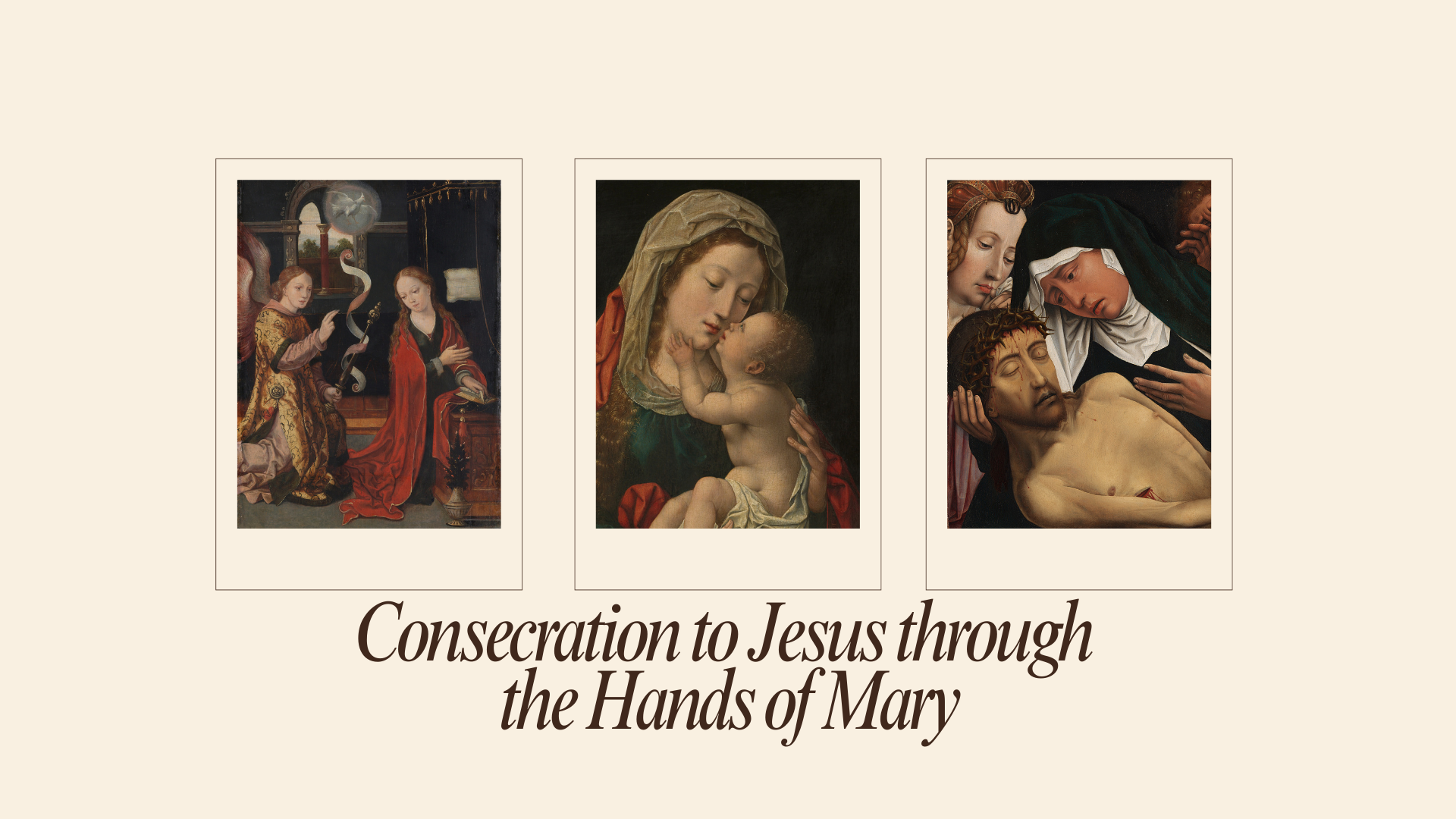
There is therefore no shame in being a slave of God, as Jesus—being God—out of His profound humility, took on the form of a slave. Indeed, it is wholly admirable to be in loving servitude to God, for truly we have nothing to offer Him that He did not first give to us. Furthermore, in His perfect obedience to the entirety of the law, Jesus chose to subject Himself to Mary as a slave. Through this, He has shown us a path to embrace a devotion of loving servitude to Mary as a means of loving Him more perfectly, always with God as the ultimate goal and end of such devotion. Consecrate yourself to Jesus through Mary. Visit this link for help: Consecration to Jesus through the hands of Mary

Just some food for thought to help you reflect and, God-willing, deepen your knowledge of God. In turn, may this also deepen your understanding of yourself—bringing you ever closer to true freedom.

On a final note, pray the Rosary!

Thank you for reading today’s post. Remember to like this post and share it with your friends if you enjoyed it. Follow me on my blog, Katmira’s blog, to receive notifications whenever I have a new post. You can also subscribe below to get an email notification whenever a new post is out. This is particularly helpful if you don’t have a WordPress account.

Let it be, until we meet again or “Ka ọ dị” as it is said in Igbo.

Note: Co-pilot was used to refine this write up.

I love this rendition!

Consecration to Jesus through the Hands of Mary

By Cynthia Aralu

Hello everyone! I hope you are all doing well and you remember to pray the rosary.

For quite a while now, I’ve felt as though I have nothing meaningful to share—like I have no voice. Whenever I wanted to express something, it always seemed like the timing was off, or my words came across as too harsh and unrefined. With that in mind, I could offer you a glimpse into my current thoughts and direct you to a consecration course to Jesus through the hands of Mary.

1. The concept of “unconditional love,” as it is often interpreted to mean, that is, the enabling of evil for the sake of love, is a distortion. Reflecting on the verse, “For God so loved the world that He gave His only begotten Son, that whoever believes in Him shall not perish but have everlasting life.”, we see that God, who is Love, has demonstrated the depth of His love for the world. Yet, He also made clear that only those who believe in His Son, sent as a perfect sacrifice, will have eternal life.

This highlights that holy love—the highest and purest form of love—maintains boundaries while remaining enduring, as mercy itself is an expression of love. You are loved as you are, but called and nurtured to be the best. This is the true definition of unconditional love. Any love that strays from or fails to align with God’s Holy Love becomes an aberration, no longer love but a corruption of the term. I believe this is reason people do not believe in love or the transformative power of love. They have imagined in their heads what love is not and defined it as love and their imaginations have failed them.

2. The world and its people are steeped in corruption—a truth that should not come as a surprise. I felt the weight of this truth profoundly last year when I renewed my consecration to Jesus through the Hands of Mary. I do not exclude myself from this observation. It is difficult to truly grasp the depth of corruption embedded in the mind of someone who has lived an unguarded life, shaped and influenced by evil perspectives. Recently, this feeling has grown remarkably intense.

Consider this: “Mary is the supreme masterpiece of Almighty God and He has reserved the knowledge and possession of her for Himself”. Yet “Mary being a mere creature fashioned by the hands of God is, compared to his infinite majesty, less than an atom, or rather is simply nothing, since He alone can say, ‘I am He who is'”. Mary herself knew and believed this truth, proclaiming, “I am the handmaid/slave of God… He has regarded the low estate of His handmaiden… He has put down the mighty from their thrones and exalted those of low degree”.

Reflect further: “God the Father gave his only Son to the world only through Mary. Whatever desires the patriarchs may have cherished, whatever entreaties the prophets and saints of the Old Law may have had for 4,000 years to obtain that treasure, it was Mary alone who merited it and found grace before God by the power of her prayers and the perfection of her virtues. “The world being unworthy,” said Saint Augustine, “to receive the Son of God directly from the hands of the Father, He gave His Son to Mary for the world to receive Him from her.” The Son of God became man for our salvation but only in Mary and through Mary. God the Holy Spirit formed Jesus Christ in Mary but only after having asked her consent through one of the chief ministers of His court.” See “Treatise on True Devotion to the Blessed Virgin”, by St. Louis Marie Grignion de Montfort

Now considering that Mary is esteemed greatly but is nothing in comparison with God, and her merits far surpass those of the saints in Heaven—who are themselves esteemed to the extent of their merits—by this true measure, I recognize how wretched I am.

3. Since “Mary loves Jesus ardently and glorifies Him more perfectly than all of God’s other creatures—saints and angels alike”, it follows that honoring Mary and the saints brings honor and glory to God. In the same vein, all creation, whether in heaven, on earth, under the earth, or in the sea, rightly gives God praise. Who could do this more perfectly when praised and honored than Mary and the saints in Heaven? Consider Mary: when praised by her cousin St. Elizabeth, her immediate response was a song of praise to God, proclaiming, “My soul glorifies the Lord, and my spirit rejoices in God my Savior…” This truth should be as evident as when one gives charity to the less fortunate and brings glory and praise to God—whether through the grateful lips of those helped, the hearts of those who witness or learn of the event, or by the charitable deed itself inspired by God. Similarly, when the saints in heaven are honored, they give glory of God as a sort of reflection, having been conformed to Him to the extent they have merited. See “Treatise on True Devotion to the Blessed Virgin”, by St. Louis Marie Grignion de Montfort

4. There is a noticeable inconsistency between truly serving God and what some individuals, who believe they are serving Him, deem acceptable—such as reading books or watching movies with pornographic content in their homes. This is just one example, yet it has become so normalized for some that their conscience has grown desensitized. They may believe their conscience is clear, even when confronted with this truth from an external observer.

5. It is inconsistent to claim to “believe and follow all the teachings of the Catholic Church” while accepting or engaging in certain practices that contradict its teachings. Allow me to list a few examples: being complacent about your children leaving the Catholic Church, speaking about confession as though it is optional, speaking negatively about devotion to the saints, accepting the use of contraception, abusing the sanctity of the marital bed, or considering IVF as an acceptable option.

A recent instance that left me unsettled involves the engagement with content where someone, under the label of ‘Christian prophecy’, examined palms to predict the future. I have been cautious in describing the activity as it was relayed to me, refraining from attaching specific labels to it. However, I was informed that it is not considered divination or palm reading—or that palm reading, in this context, is not divination—but I struggle to see how the conclusion could be otherwise, even if it is rare in its occurrence, as I’ve been told. I believe the truth will come out one day.

Ironically, it would be better to follow all the teachings of the Catholic Church in simplicity, even without raising “wise questions” or trying to be wise in one’s own eyes, as such simplicity in faith could make one truly wise.

6. There is no greater mother than Mary. Even if I falter, I trust her to guide me back to true contrition and repentance. I rely on her to show me the best way to please her Son, Jesus, who, in His love, has chosen to be my brother. This was once a source of concern for me, but through the consecration course, I learned to entrust myself to her care. Now, I feel a deep sense of peace, knowing that she intercedes for me before Jesus.

7. Why go to Jesus through Mary? It pleases Jesus, as it is the most perfect way He chose to come to us, and thus the most perfect way for us to go to Him. Furthermore, since Jesus is God, just as God the Father is God, and we have been given Jesus Christ as a Mediator between us and the Father, it is fitting that Jesus, being God, would also have a mediator. Out of His profound humility and perfection, He gave us Mary—not out of necessity, but because it is the most humble and perfect way He chose to unite Himself with humanity in the flesh; through her.

Humility is not easy, and in today’s world, its meaning has been lost. Many have also lost a sense of a Holy Fear of God, to the point where roles and stations are no longer given their due regard. I personally grapple with the concept of humility, as it feels foreign to me. Yet, in Heaven, hierarchies exist as part of God’s divine order.

8. There is a consecration course set to begin on March 24th, led by the Heralds of the gospel. I will renew my consecration to Jesus again this year by God’s grace.

“The Consecration Course is based on the Treatise on True Devotion to the Blessed Virgin, by St. Louis Marie Grignion de Montfort, a prophetic work and a theological document of the utmost importance. A daily video lesson will be on Heralds of the Gospel’s online catholic course platform (“Reconquest Platform“)”. 

  • “The first class, on the evening of the 24th of march, will be a Live on Youtube at https://live.heralds.org/
    On consequent days, you will be able to attend each day’s class at your convenience. The classes will be recorded and will be available from 5 a.m. 
  • To easily receive all the information, you can join their WhatsApp group – although this is not necessary: click here.
  • Send any questions you have to: consecration@heralds.org
  • To join the consecration course, sign up at this link: https://consecration.heralds.org/slei
  • Alternatively, if you are wary of links, google “Reconquest Platform Heralds of the Gospel”. It should be easy enough to navigate to the free consecration course that starts on March 24th and ends on April 26th.

Here is an another excerpt from the True Devotion to Mary: Consequently, this great Lord, who is ever independent and self-sufficient, never had and does not now have any absolute need of the Blessed Virgin for the accomplishment of His will and the manifestation of His glory. To do all things He has only to will them. 15. However, I declare that, considering things as they are, because God has decided to begin and accomplish His greatest works through the Blessed Virgin ever since He created her, we can safely believe that He will not change His plan in the time to come, for He is God and therefore does not change in His thoughts or His way of acting.

On a final note, pray the Rosary!

Thank you for reading today’s post. Remember to like this post and share it with your friends if you enjoyed it. Follow me on my blog, Katmira’s blog, to receive notifications whenever I have a new post. You can also subscribe below to get an email notification whenever a new post is out. This is particularly helpful if you don’t have a WordPress account.

Let it be, until we meet again or “Ka ọ dị” as it is said in Igbo.

Note: Co-pilot was used to refine this write up.

Music in Me

By Cynthia Aralu

Hi everyone. Remember to pray the rosary!

When I was a kid, I would sometimes hear an orchestra playing in my head. The music was so beautiful, and I wished I could play it out, but I didn’t know how to play any instrument other than the recorder, and I wasn’t very good at it. I told a friend on the school bus about it, and she didn’t call me weird. Later, I watched the movie “August Rush,” about a boy who could hear a symphony in his head, and I think I wondered if people might think I was lying if I shared my experience. I also found it interesting that a movie portrayed a kid experiencing this. As I grew older, I stopped hearing the music.

Two nights ago, I had a dream where I sang a song to Jesus, and I woke up with the tune still playing in my head. I recorded it and sang it a few times during the day, and I could hear in my head how the production would sound, even the symphony and blend of voices. It wasn’t until today in church that I realized I had heard music again. I could not help but wonder if perhaps a part of my innocence had been healed. Sometimes, healing comes so subtly that you don’t even realize it has happened until it has.

Recently, I’ve been learning that attraction can be manipulated by the evil one, even if it starts off as something good or somewhere good. I found it difficult to get someone out of my head. You might wonder why it’s a bad thing to think about someone you like. The thing is, I didn’t know this person well, only a general awareness of him and his actions in church, and he smiled at me. I could only see virtues which made him attractive to me, but I didn’t know him well enough to say I liked him; at best, I was curious.

Another reason I found it problematic was that I did not have custody of my mind. My thoughts never wandered to anywhere sinful and never beyond my encounters with him or fantasies of what could be, but still my body was weak and easily excitable. Even my perception of him was altered. He appeared more physically attractive to me. Like he had a glow and my eyes would catch him everywhere my head turned. I prayed to God several times to take it away and to help me have control of my mind. I also went to confession hoping for the grace I have always received to overcome any vice I bring forward to confession. It persisted even after confession. Then, I admitted to Mother Mary that there must be a part of me that wants this even if I did not like it. The bible says, you will know the truth and the truth will set you free and I wanted to be free, so I was careful about admitting my fault with that in mind. I left the church that day feeling exhausted.

During this time, I leaned into praying to the Holy Spirit for self control. I learned to see all men as my brothers and nothing more. This revelation slightly deadened the attraction, and I felt a freedom within me when I decided not to kiss a man until marriage. I believe this is the way it is supposed to be, although, others might argue differently. I have a hard time believing a couple could “always” exchange chaste and pure kisses. I realised as well that humans were made by God for truth and to recognise the truth. The reason we do not always do this is because of sin, and “the man” was blessed with a knowing of this truth at his creation. It is the only way he would have been able to name all animals in the garden of Eden and do it excellently without sinning. So, a man fully aligned with God’s will, will always be able to recognise the truth with God’s help. This isn’t to diminish women, but I wonder about where the saying “woman’s intuition” comes from, and about the manner it is used as though it is a special gift limited to women when “the man” was first blessed in this way by God. I want a man who is lead by God to know the truth because he is in alignment with God’s will, and I do not want love to be awakened in me until it pleases, so to speak. It is one of the reasons I did not trust my feelings. It went against my beliefs and desire.

Anyway, I still didn’t have full control of my mind until I asked God some questions since I could not figure it out. “Do I like him?” “Am I attracted to him?” “Should I be attracted to him?” or something similar. It felt like a fog lifted, and I regained custody of my mind. Later, I asked similar questions to God for good measure. “Do I like him? Am I attracted to him? Should I be attracted to him? If I should not be attracted to him, then please take it away”. However, since the first time I asked the questions to God, I have had control of my mind in that area. So, I was being unnecessary, surely out of a desire for it to be permanent.

I remember feeling weird and perhaps melancholic afterwards that day, and when seated in front of Our Lady of Guadalupe in church, because it felt like I had been on a high only to crash quickly. I was grateful to God for everything I had learnt but I was annoyed that my feelings had been manipulated so, I prayed against the evil one, as I felt so aware of his plans to destroy me. I was also concerned that my feelings were so easily manipulated and wondered if I was really okay. So, I prayed to Jesus about it for His healing. I am thankful to God for His grace. I believe I have been healed.

There were some “God coincidences” during that time, which are really no coincidences at all. I remember a thought came to me during that time, “Be open (Ephphatha)”, and I recalled the bible passage where Jesus healed the deaf and dumb man. I prayed for God’s help to be open to His will and to do His will. Then, I heard the bible passage about the healing of the deaf and dumb man read in church during daily mass. I considered the creation of Adam and Eve, and then it was one of the passages read during daily mass last week. Another was that I remember praying a rough form of “God’s will is my will” at some point during that time, and afterwards, stumbling across an Instagram post about a quote from St. Alphonsus Liguori, that one should accustom oneself to saying in times of trial, “It is the will of God; it is my will also”. Now, I often pray, “God’s will is my will,” and I feel my will bolstered.

I can’t say that I know everything about this series of event. In fact, I have a feeling there is still more to learn that I do not know yet. It is the reason that at first I hesitated to write this post. But, I suppose I will worry only about today and bask in the joy of knowing that I am able to hear the music again and that God is in my midst, a Warrior Who gives victory; Who will rejoice over me with gladness, Who will renew me in His love and Who will exult over me with loud singing as on a day of festival.

On a final note, pray the Rosary!

Thank you for reading today’s post. Remember to like this post and share it with your friends if you enjoyed it. Follow me on my blog, Katmira’s blog, to receive notifications whenever I have a new post. You can also subscribe below to get an email notification whenever a new post is out. This is particularly helpful if you don’t have a WordPress account.

Let it be, until we meet again or “Ka ọ dị” as it is said in Igbo.

Note: Co-pilot might have been used to refine this write up. I honestly can’t remember at this time but in recent times, I have found it to be a handy tool for editing.

A lovely song you could listen to!

An Invitation to Love

By Cynthia Aralu

Hello everyone! Remember to pray the Rosary!

January was a long and busy month, and I’m still working on getting back into my daily mass routine after returning from Houston and moving recently. I am thankful to God for another month in this new year. Since my last blog post, I’ve learned more about myself and discovered a missing piece. Before the year was over, I was called selfish in a situation where I believed my reasons were justified, but it was perceived differently. This made me wonder, if I couldn’t handle being called selfish by a human, how would I bear it if God called me selfish? It was a chilling thought. So, I resolved to accept insults from people, keeping that in mind, to prepare myself for that day.

I’ve also reflected on my last blog post, wondering if it came across as selfish. Since being called selfish, I’ve been questioning my actions, asking myself, “Is this selfish?” and “Am I being selfish?” I thought maybe my blogpost seemed selfish, but my heart and intent weren’t, as the post didn’t capture the full context or my complete feelings. I considered other details I hadn’t included, not intentionally, but because they didn’t come to mind while writing. Who is to judge the heart but God?

Those accusatory words and my blog post propelled me to delve deeper into lessons I previously only understood superficially. This principle might seem simple or straightforward to you, who are wise, and maybe I had heard it before, but it only truly registered when I watched a video about suffering last month. The video mentioned, “There is no love without sacrifice. How could a mother claim to love her child without sacrificing for that child,” or something similar. Then, I realized my inclination is to desire to love without pain, but the pain and sacrifice are proof of the genuineness of my love. Here is a link to the YouTube video: Heralds of the Gospel – What CATHOLICS are not told about FASTING

All through last year, God invited me in so many ways to love Him. So, the year I couldn’t say I enjoyed was actually filled with moments where I loved God, a lot of moments I previously saw as inconveniences. Although, this does not apply to every moment, it felt like last year was marred by struggles. Yet, even the lows, which I didn’t enjoy, were highs in disguise. My perspective was just skewed. So, I resolved to welcome this year, by God’s grace, with the joy of knowing that this moment, this time, God is inviting me to love Him. It’s an opportunity.

I had equated loving God with loving my neighbors, and in truth, to love God is to love your neighbors. What I hadn’t considered is that to love God means to love everything He has willed to come my way, knowing it’s for my benefit. In fact, knowing the weakness of my will, these seemingly inconvenient moments are necessary for the salvation of my soul, if I cooperate with His grace. Cooperating with His grace will look different each time and doesn’t necessarily mean doing nothing.

Since having these thoughts, I’ve joyfully embraced everything God has sent my way, doing my best by His grace and offering it all up to Him. When I reflect on January, much of it has been focused on this. I try not to get too upset when things go wrong because I have a goal in mind. I don’t always get it right and I’m not perfect, but that’s okay. With time, I will perfect this by God’s grace. It’s such a privilege to be invited to love God. How many people truly realize this?

On a final note, pray the Rosary!

Thank you for reading today’s post. Remember to like this post and share it with your friends if you enjoyed it. Follow me on my blog, Katmira’s blog, to receive notifications whenever I have a new post. You can also subscribe below to get an email notification whenever a new post is out. This is particularly helpful if you don’t have a WordPress account.

Let it be, until we meet again or “Ka ọ dị” as it is said in Igbo.

A lovely song you could listen to!

A Happy Death

By Cynthia Aralu

Hi everyone! Remember to pray the Rosary!

Have you ever wondered what a happy death is? I did at the start of my reversion to the Catholic faith, since I prayed the Rosary regularly; the intention of the 4th Glorious Mystery (The Assumption of Mother Mary into Heaven) being a “Happy Death”, and presently, it is regularly on my mind.

I suppose at the start of my reversion, I might have imagined a happy death to mean a good death. I am trying to recall what conclusion I came to at the start. What is a good death? Is it to live comfortable, amassing wealth, love, fame, and then to die, and to cease to exist? The Catholic belief is that those who die in God’s grace, go to Heaven eventually, after a purification process. The Word of God says, “Nothing unclean will see God.”. So, is it possible to go straight to Heaven? One would have to be completely purified at the moment of death for them to go to Heaven straight away and how many can be so confident, without being foolish, that at the moment of their death, they have renounced all attachments and cling solely to God. I think I have heard it spoken of that it is also a Catholic belief that you can go straight to heaven after you die. Blessed Carlo Acutis spoke of going straight to Heaven. I think St. Therese of the Child Jesus did as well. St. Therese is a gem amongst gems. Then, there is St. Cecilia, who I learnt of recently and I was so in awe of. I think she went straight to heaven. She is so pure and beautiful. When I think of the saints, I think of how I am nothing like them.

I think I heard it said a “Happy Death” is to die in God’s grace and not about living a good life and then dying, by man’s standards. I suppose I might have imagined dying in my sleep, free of troubles and illness, when I considered a “good death”. I know of someone who prayed to die free of illness or long illness. I do not know if she died that way. I came to a place of no fear about death, and even thought recently that I could be dying while I slept one night. I felt myself floating upwards in that dream and thought, “Am I dying?”. I resigned myself to it and prayed, “Father, welcome me into your arms”. Then, I remembered I ought to pray for the forgiveness of my sins, which I did. Immediately, I prayed a prayer of contrition, it felt like my soul was slammed back into my body. I don’t know if the following happened right after, but while my eyes were still closed, an image of a smiling woman carrying a baby took shape in my head. It was like a drawing coming to completion. I remember clearly that at least either the woman or the child had chubby cheeks, possibly both did. And their youth, beauty, and cuteness was so evident. I have never seen that drawing in real life. I thought it was Jesus and Mary as I watched. This happened the Sunday of the first week of October.

I have watched people say it is normal to regret not doing a lot of things before dying. I have also heard it said it is naive not to fear dying even a little bit. Additionally, I heard it said it is foolish to just want to die, without considering the need to receive final rites or viaticum, and that it is the way to have a “Good Death”, and perhaps there was talk of a battle that happens at the moment of death. This is my interpretation of the things spoken. Perhaps, I misunderstand these people. I have considered those lines of thinking and perhaps I am the most foolish of them all for not being encumbered by such ways of thinking.

I have concluded that those ways of thinking produce fear, and I lay all my fear and anxiety at the feet of Jesus, at the foot of His cross, begging Him to redeem it and redeem me to glory of His Name, for my salvation and the salvation of others.

While having final rites done for you is a good thing, do I think everyone who have died or will die without final rites do not have a fighting chance of going straight to heaven or that they have less of a chance? The battle is God’s after all. Do I think I have a fighting chance at any point in my life, apart from the abundance and unending nature of God’s grace and mercy and Mary’s intercession for me.

I imagine even if I stood before Him and I was accused of the most heinous crimes and they were all found to be true, He is justified in condemning me, because He is all good and all righteous and I will accept His righteous judgement as true, without forgetting as well another truth, that even though there is no good in me, the Mercy of God never ceases, and I would beg for mercy with all the confidence of a child that knows it is loved without measure. This is a prayer and hope of mine. And so, I pray frequently and earnestly for a “Happy Death”, knowing that I will never be surrounded by love on this earth to the magnitude that I would be when I get to Heaven. I also earnestly run to the Blessed Virgin, ever confident in her love and intercession for me. I pray that Jesus and Mary are there at the moment of my death to lead me to Heaven. Knowing me, I will get lost without them.

I imagine a “Happy life” will be dictated by union with God after death or should I say a “Happy death”. I will be able to say “I lived a full life”, when I am in Heaven, not before. I count my life as loss, if it means I am separated from God. A happy life to me, is a life which terminates in friendship with God, whether rich or poor, loved or hated, young or old. There is no reason to despise the rich or to despise the hated or consider them going to a worse place than you are when death comes. You do not see their heart or know their destination and you could be wrong about them. The same God who loves you, loves them too. You would be better off praying for them to get to Heaven, not forgetting to pray for yourself too. So, I think there is no right station to be assigned to in this life, only a right way of living; a life lived loving God with your whole heart, with your whole soul, with your whole might, a life lived loving your neighbour as yourself. Go and learn what that entails by seeking God through Jesus, while He still can be found, and do it in truth. He will draw near to you.

I think I should say that I am not encouraging sinning so that God’s mercy presses even greater upon you. It should be obvious but it isn’t always.

I will end this post with the prayer from the Divine Mercy Prayer that I encourage people to pray and meditate on: “Eternal God in Whom mercy is endless and the treasury of compassion inexhaustible, look kindly upon me and increase Your mercy in me, that in difficult moments we might not despair, nor become despondent but with great confidence submit ourselves to Your holy will which is love and mercy itself”. You see, it really is in showing mercy or in the abundance of mercy that is in us, that we are able to hope that mercy will be shown to us. I just realized this.

On a final note, pray the Rosary!

Thank you for reading today’s post. Remember to like this post and share it with your friends if you enjoyed it. Follow me on my blog, Katmira’s blog, to receive notifications whenever I have a new post. You can also subscribe below to get an email notification whenever a new post is out. This is particularly helpful if you don’t have a WordPress account.

Let it be, until we meet again or “Ka ọ dị” as it is said in Igbo.

A lovely song! Take a listen!

“Love”

By Cynthia Aralu

Hi everyone! Remember to pray the Rosary!

I have been going through some things which I shan’t go into details about, but I will say this, I have learnt that a stranger will give love more readily than someone you consider close. Better to run to that stranger, than someone you think is close. But a stranger is a stranger for a reason, and I think as the saying goes, familiarity breeds contempt…hmmm, or is it disrespect. Better yet, run to God Who never fails.

I flinched when someone told me “I love you.”. It is hard to hear those words when you have been beat up emotionally by the person saying them. The words became easier to digest over time, to understand and to love. I cannot take credit for this transformation. Only God can do this.

I also prayed and hoped to God for something I desired. I moved forward courageously, when I had not a lot of courage, and prayed fervently for His peace. I thought I heard Him say to go forward but things did not work out as I had hoped. I wondered if indeed I had heard Him. Maybe not but also maybe I did. I do know looking back at it from a close distance, I can see that I have learnt some things from the experience so far. I have a richer understanding of what it means when God forgives you. It is written that God forgets your sins when you repent, and He forgives you. It all made sense to me amid a chaotic moment that was unrelated in matter to God’s revelation to me, but congruent in weight or depth of expression. The potent revelation I received made me realize in a striking manner which my soul is wont not to forget, that I will not crucify myself for my mistakes and God does not want me to do so either. “As far as the east is from the west, so far does He remove our sins from us”. “I, I am He who blots out your transgressions for my own sake, and I will not remember your sins.”

Oh, I felt ecstatic and hopeful when things did not go my way, and instead of grief, I thought to myself that this is all for the Glory of God, for my salvation and the salvation of others. Later on, I felt grief, but it did not overtake me like it had in the past. It made me long for the Heavenly Jerusalem just like Abraham and the saints did. I told Him that perhaps I did hear from Him and I will take this event as discipline. God disciplines those He loves, so He must love me so much. God loves me so much, this I know.

Afterwards, I considered the love between a husband and a wife. I have been trying to have a God-like view of what that dynamic is supposed to look like. I remembered the portion of the bible where St. Peter exhorts wives to treat their husbands in the manner Sarah did, when she obeyed Abraham and called him ‘lord’. I was critical of the word “lord”. What did that mean? It sounded reverent but also, I couldn’t help but think about subjugation combined with inflexibility, judgementality, hypocrisy and inconsideration. I know of a traditional, catholic man who was this way. I also know of a middle class protestant Christian who was very considerate to his wife, he treated his wife like an egg. I know of a rich, liberal man who was conservative when it soothed him, so his wife suffered because he did not help whether by contract or by self, and he did not encourage the best for his wife. Finally, I know of a traditional African man from a largely patriarchal society, who did not want His wife to cook, hired help for her and of his own volition, made arrangements for her to get a higher education. That African man would have been made perfect if in other ways, had he practiced the Christian faith, and yet he was quite generous in nature in a lot of ways and God blessed him. It is an irony that the faithless are able to love in ways that the supposed faithful do not.

My mind also wondered if the vision of calling your husband “lord” could be akin to the victorian era where some men were called lords and some women were called ladies. To them, it might have been a surface synergy of Class meets Class on a level of some sort, but to Christians, should it not be a synergy of joint heirs to the grace of life; one heir of the Kingdom of God to another?

To my mind, I have only one Lord. My mind moved on to another bible verse when I considered how my Lord displayed His Lordship, and in turn taught through his actions and words, how the disciples ought to treat one another. It was on the day He washed their feet, a day before they would desert Him, and one would betray Him. Knowing this, He washed their feet. At another time He said, “You know that the rulers of the Gentiles lord it over them, and their great men exercise authority over them. It shall not be so among you; but whoever would be great among you must be your servant, and whoever would be first among you must be your slave; even as the Son of man came not to be served but to serve, and to give his life as a ransom for many.”

A lord by this definition is one who is a slave and servant of his wife, and pours himself out completely, without counting the cost, to the point of death. I looked up at the picture of the cross at the moment this came to mind while praying…or perhaps I was looking at it already without registering it. I should have been meditating on the “Crucifixion of Christ” because I was praying the seven sorrows, but my mind had been restless. In any case, the love I am considering is a life-giving love. It is so powerful that I stumbled over my thoughts. A healed woman or a woman open to healing would desire or crave to submit to that man and defend that man wherever she went to. She would sing his praises everywhere and she would be able to trust him.

And so, I asked God, “What man can love like that?” I wondered if it was even possible but then again, I remembered St. Therese of the Child Jesus. I had never gone through any writing of anyone before her, I don’t think, who burned with a desire for martyrdom. No one except Jesus. Although, as I write this now, a few do come to mind. I heard the account of St. Ignatius recently, how he begged the early Christians not to save him from being torn apart by lions. St. Paul as well….oh, and another saint who did evangelical work, but I do not recall his name. All things are possible through God’s grace.

If I am to consider this idea further as I write this, “We love because Christ first loved us.”. The man loves first through dying to himself and calls out a submissive expression of love from the woman. That is not to say that love must always be received for it to be given. On the contrary, I believe there is infinitely more merit in loving when you are not loved. I think one would be better off with a lot of prayer, placing greater scrutiny on the type of dynamic or relationship one chooses to have great proximity to for the rest of their life, and face (focus on) God whether or not they are blessed with this, and if not given, to die with joy and go to God. So, I am in fact considering a healed dynamic or one open to being healed when I write about a submissive expression of love which a man call out of a woman through loving in dying to self. On the other hand, the woman submits even though the man fails, and the man loves sacrificially even when the woman fails. It is easier said than done. That is why one should pray to God if in that situation, that God should help one love. God is always ready and willing to help you love. I know this because He always helped me whenever I asked for help to love….to be patient.

I do not understand the saying that one can love without respecting, perhaps this is why I have difficulty. I subscribe to the bible’s view of love and it is not bound or limited to gender. “Love is patient and kind; love is not jealous or boastful; it is not arrogant or rude. Love does not insist on its own way; it is not irritable or resentful; it does not rejoice at wrong, but rejoices in the right. Love bears all things, believes all things, hopes all things, endures all things”. Looking at this, I cannot believe respect can be separated from love, so, I do not know how one could prefer to be respected over being loved. I wonder though, if the respect some men claim they want is the stroking of their ego, the fanning of their pride. This is what I have observed from a small sample size. But then again, I am not married and some might think me bitter because of it. Ultimately, what do I know except what I have observed, and what is the point I am trying to make by writing all of this?

I suppose the point of this is to share my thoughts, so that in doing so, someone out there does not feel alone in this vastness that is the universe; the point of my blog really, lest I forget.

On a final note, pray the Rosary!

Thank you for reading today’s post. Remember to like this post and share it with your friends if you enjoyed it. Follow me on my blog, Katmira’s blog, to receive notifications whenever I have a new post. You can also subscribe below to get an email notification whenever a new post is out. This is particularly helpful if you don’t have a WordPress account.

Let it be, until we meet again or “Ka ọ dị” as it is said in Igbo.

A lovely song you can listen to!

Testimony

By Cynthia Aralu

I waited patiently for the Lord;

He turned to me and heard my cry.

He lifted me out of the slimy pit,

out of the mud and mire;

He set my feet on a rock

and gave me a firm place to stand.

He put a new song in my mouth,

a hymn of praise to our God.

Many will see and fear the Lord

and put their trust in him.

Psalms 40:1-3

Hi everyone! Remember to pray the Rosary!

I have been meaning to share about God’s blessing to me and to give thanks to God in the presence of everyone like the Psalmist says: “Let them extol Him in the congregation of the people, and praise Him in the assembly of the elders”.

I held back at first because I couldn’t say anything at the time and then later on, I suppose I started to overthink everything. I got a new job within the same role at the same workplace and it gives me the opportunity to gain more project management experience while I make plans for my future. I give thanks to God for the opportunity that he has given me and it is my hope that I am able to be courageous and kind within this role, always keeping God at the forefront of all that I do. I pray for the grace to do good, for God’s guidance in all that I do, for God’s help to gain all the experience that I need. I must admit the role fills me with uncertainty about a few things but all I have to do is trust God and love as God desires. With God, I can do anything.

On a final note, pray the Rosary!

Thank you for reading today’s post. Remember to like this post and share it with your friends if you enjoyed it. Follow me on my blog, Katmira’s blog or my podcast, Amara’s Musings, to receive notifications whenever I have a new post. You can also subscribe below to get an email notification whenever a new post is out. This is particularly helpful if you don’t have a WordPress account.

Let it be, until we meet again or “Ka ọ dị” as it is said in Igbo.

God bless you!

A lovely song you could listen to!